HOME

May 18, 2007

Anatomy of a Summer Stock Season

I call this: summer stock,theatre — Posted by KP @ 12:00 pm

Hey, it’s a new feature! This is the first post of what will become something of a sub-blog here for the next few months. I intend to blog frequently over the summer to give a complete picture of my season as production stage manager for The Reagle Players in Waltham, MA. There’s a new “summer stock” topic over on the sidebar yonder —->, which will narrow down to only these posts.

So how did I get this job?
I first came to this company two years ago when I received a phone call from Scott Mikita, one of the actors in Phantom. He was calling to see if I’d be interested in stage managing at a theatre he and his wife Sarah Pfisterer (who I knew from her days as Christine in Phantom) had worked with before. They were going to be performing in the shows that season (he had gotten a leave from Phantom to do the first one, she was doing the second and third), and the producer had asked them if they could recommend any stage managers in New York.

Going off into the unknown like that is a little scary when you don’t know the company, and living in the suburbs for three months without a car could have been miserable, but I knew Scott and Sarah wouldn’t be returning if it wasn’t a great place to work — hell, Scott was giving up his Broadway paycheck to do it — so I was convinced it was something I wanted to do. A lot of my remaining anxiety was eased at the last minute when it was determined that I should have my own car, which in hindsight was an absolute necessity. One thing I really appreciate at Reagle is that even when the budget is tight, they will always make sure I have what I need to do my job.

A brief history of The Reagle Players
Reagle is celebrating it’s 39th season this year. The founder and producer is Robert Eagle, or R. Eagle. REagle… get it? They started out as a community theatre, and now operate under an Actors’ Equity Letter of Agreement contract, which means that the company consists of a mix of professional Equity actors, professional non-Equity actors (mostly from New York and Boston), and local actors who work for free, many of whom have been with the company for a long time. So it’s a nice mix of community theatre and various levels of professionals, from college students to Broadway and movie stars, with lots of talent at all levels.

    Equity-speak for anyone who cares: The contract is an LOA referenced to COST. Generally there’s a requirement of seven Equity actors per show, two of whom must be in the chorus. This does not include me, and I can never remember if it includes my assistant, who is an Actor/ASM. I believe it does not, as I seem to recall always having to count to 9 in matters involving Equity members. Non-Eq actors are able to work for Equity Membership Candidate (EMC) points, and we’ve had a couple actors earn their cards during shows in the two years I’ve been there (EMCs who are expected to earn their cards during the run don’t count toward the required 7 Equity members).

The Theatre
The Robinson Theatre seats about 1,100 and is situated inside Waltham High School, and is supplemented by a recent multi-million-dollar addition that Reagle helped to pay for, including a dance studio of the same size as the stage, an enlargement of the scene shop that I’d say at least doubled it, as well as the basement storage where a lot of the costumes, props and drops are stored. In addition, the lobby was enlarged to double its original size, with a full-length glass wall looking onto a courtyard. Waltham High also uses the theatre and dance studio, so the first show of the season always has to take into account activities like dance classes during the school day, graduation events, etc. The whole theatre wing of the building is kind of separate from the rest of the school — just the box office, theatre and related backstage areas, dance studio, and a few music rooms which are used as additional rehearsal space. It’s really a very nice facility, and there’s nothing “high school” about it. When rehearsal space is tight there’s also a nearby dance school with two studios in this old schoolhouse type building that we rent. I much prefer being at the theatre though, because on most breaks I like to stroll down the hall to the stage or the shop to see how things are going with the set and other technical matters, and there’s usually somebody who wants me to take a look at something. Oh, and P.S. the old schoolhouse has no air conditioning.

The Schedule
Thankfully, this is not the crazy summer stock schedule of doing a new show every week while rehearsing the next during the day. Every show takes four weeks. The first two weeks are rehearsals. On the Saturday of the second week, tech starts. (I’ve developed a little something I call “pre-tech,” but I’ll save that for when the time comes.) The beginning of the third week is dress rehearsals, and the show opens on Thursday. Performances run the rest of that week, and all of the fourth week. The show closes Sunday and the following Tuesday rehearsals begin for the next show. It could be much, much worse, and for that I am grateful!


OK, enough background, start blogging!

So what have I done so far? Well I like to go in knowing the show itself as well as possible. What I learned the hard way on my first show at Reagle is that because there are almost always two or three simultaneous rehearsals going on (actors, singers, dancers), and my assistant is a dancer in the show, I can’t bounce around very easily and see what everyone is working on. I’m almost always in the acting room with the principals and the director, taking blocking. This is all well and good, but when it comes time to put on a show, I’m going to be the world’s expert on some long, boring book scene with no cues, and there will be a massive 10-minute dance extravaganza with 50 cues that I’ve never seen.

Life Lesson #1: Sometimes I just need to leave my rehearsal.

My helpful assistant, Paul, keeps an eye on what the ensemble is doing, and we check in on breaks and via text message during rehearsal, and if they’re running a finished number, or large chunk of a number, he’ll tell me when to stop in so I can see the most stuff in the shortest amount of time. I don’t need to be there when they’re learning step-ball-change, though if there’s no blocking rehearsal I need to be at instead, I do enjoy sitting in on the dance and music rehearsals, because learning it as the dancers and singers learn it helps it to sink in better, instead of trying to absorb it all at once as a finished product. Anyway, the willingness to stand up and say, “I need to be in the other room right now” has helped me a lot in preparing myself for tech and performances, and usually doesn’t inconvenience the blocking rehearsal very much, if at all.

All that to say, I try to go in ideally with the score memorized from the start. That almost never happens, unless I’ve done the show before, but I try. This year we’re doing 42nd Street, which I will confess I haven’t listened to a note of since it was chosen, because I’ve done it before. My big concern for the last few months has been King and I, because it’s a great big classic show that I really don’t know. I have this friend Amy, who has like every show CD ever, or at least it seems that way. Around February, she’s taken to asking “So what CDs are you going to need to borrow for this summer?” When I ask if she has a certain show, the response is usually, “Broadway or London? Original or revival?,” followed by her recommendations of which one I should be spending more time listening to. Because Singin’ in the Rain has no cast recording, I only needed King and I, so predictably, a day or two after my request, I find waiting for me at the Majestic both the original and the Donna Murphy/Kevin Gray revival. I put them both on my iPod and start listening to them as much as possible.

In my head, I think I know the season: 42nd Street, King and I, Singin’ in the Rain. I know King and I is second, because Sarah Pfisterer is playing Anna, and whenever I’m at Phantom Scott Mikita keeps me updated on anything at Reagle I may have missed, and this is one of the things I had heard from him. I ASSUME (you know what happens when you assume) that Singin’ in the Rain is last, because the story I’ve heard is that it always has to be last, because the rain ruins the deck, and this way the deck gets rebuilt at the end of the season. Makes sense, right? One thing I knew but was somehow in denial of the significance of, is that the deck was already a mess last year. I said to myself, too bad we have to do another whole season on it before putting it out of its misery with the rain. So last week I was on the phone with the producer’s assistant just checking in, and he asked if I knew the season, and I said yeah. “42nd Street is first, right?” “No, 42nd Street is last.” Uh oh. I know King and I is the middle show, so that can only mean Singin’ in the Rain is first. Of course it is, because that way the deck gets replaced mid-season (big job for the crew, but I’m sure they can handle it), and then we have a nice new deck for the rest of the shows. Only problem is I had been comfortable in the knowledge that I have the first two months of the season to prepare for that monster of a show, pore over the script and score, watch the archival video a million times, question all the experts in each department who have done it before, and I should be fine. Well now I have to do it first.

Life Lesson #2: Make sure you’re absolutely positively completely certain you know the order of the shows.

Ever since I first set foot in Reagle-land, Singin’ in the Rain has been something of a legend. It might be the most award-winning show Reagle has ever done, so much so that the first time they did it (2002), it was so popular that they did it again the following year. It’s the show every other show is compared to, certainly internally, and I’ve also heard it when walking through the lobby at intermissions and after shows. “I think this one might have been as good as Singin’ in the Rain!” “Really? No! Nothing could beat that.”

It’s also legendary in a different way with the crew. Since the day I arrived, I was told, “God help you if we ever do Singin’ in the Rain again! Run away! Run away!!” I’m always up for a challenge, though, and when rumors began flying at the end of last season, I was looking forward to confronting the beast and conquering it. The set is huge. Everyone gets wet. That’s basically what I’ve gleaned from them. My take on this is: We know the set fits. Maybe not easily, but it fits. And I will be dry in the booth. My expectation is that it will be much worse for the crew than for me, and hopefully we’ll keep everything on track and it won’t be so bad for them either.

So what I’m currently doing is waiting for a package to arrive with my emergency Singin’ in the Rain-learning supplies. I’m comforted that pretty much everyone but me has done the show before, and the last production was very well documented. There is a wealth of knowledge at Reagle, both in paperwork and oral history, on any show they’ve done before (which is most of them), so when I need to know how something works there’s always someone I can talk to with firsthand experience.

I also booked my train ticket on Amtrak this week. We’re provided with bus fare from New York, but I never use it. I like trains, I hate buses. It’s worth it to me to pay for it. I actually got a good fare this year, so I upgraded to business class. I use those four hours to get a lot of work done. I have traditionally used the train ride to do the first show’s contact sheet and put all those names and numbers into Entourage and sync them to my Treo. That deserves a post in itself. Maybe I’ll write it on the train.

May 4, 2007

Things Never Said in Theatre

I call this: theatre — Posted by KP @ 8:49 pm

The following list is not my creation, but is one of those things that has been floating around for years, photocopied and posted on callboards far and wide. I first saw it on the callboard at Phantom a number of years ago, and I had to make a copy for myself, as it’s the most true assessment of what it’s like to do a show that I’ve ever read. Paper is so last century, so I felt I should transcribe it here so it can be shared more easily. I’ve also seen some other versions online with added entries and included some of my favorites from those.

Things Never Said in Theatre


By the stage manager:
It looks as though there’ll be time for a third dress rehearsal.
Take your time getting back from break.
We’ve been ready for hours.
No, I called that perfectly the first time — let’s move on.
The headsets are working perfectly.
The cue lights are working perfectly.
The orchestra has no complaints.
The whole company is standing by whenever you want them.
That didn’t take long.
No thanks, I don’t drink.

By the producer:
Of course there’s enough money to go around.
We have money left over.
No thanks, I don’t drink.

By the director:
Wow, the designers were right on, weren’t they?
No, today is the tech rehearsal, we’ll re-work that scene later.
I think the scene changes are too fast.
The sound is great!
Of course I think that we’ll be ready in time for opening.
We’ll use it as it is.
The crew? Why they’re just wonderful!
No thanks, I don’t drink.

By the choreographer:
This floor’s fine.
Plenty warm enough, thank you.
Thank you.
The lights are spot on.
Leave it; we’ll fit in somehow.
The costumes are perfect.
The boom positions are fine.
The wing space is ample, really.

By the designers:
Of course all my drawings were turned in on time.
Yes, it is absolutely my fault the set looks awful.
You know, you might have a point there.
The director knows best, obviously I wasn’t giving him what he wants.
We have too many gel colors in stock, I can’t choose.
I have lots of spare instruments.
I’d be happy to move that instrument so you can hang a speaker there.
Of course the shop will have the costumes ready on time.
The actors are always in their light.
No thanks, I don’t drink.

By the technical director:
This is the most complete and informative set of drawings I’ve ever seen.
We built it right the first time.
No problem, I’ll deal with that right away.
I love designers.
No thanks, I don’t drink.

By the actors:
Don’t… Let’s not talk about me.
Really, I think my big scene should be cut.
This costume is SO comfortable.
I love my shoes.
No problem. I can do that for myself.
I have a fantastic agent.
Let me stand down here with my back to the audience.
I’m sure someone told me there was a wall here, I just forgot.
I can hear everything I need in the monitors.
Without the crew the show would never run; let’s thank them.
No thanks, I don’t drink.

By the stage crew:
That instrument is not in the way.
There’s room for that over here.
We’ll get in early tomorrow to do it.
No, no I’m sure that is our job.
Anything I can do to help?
All the tools are carefully locked away.
We’ve made sure there are no screws on stage that the actors might step on.
Can we do that scene change again please?
It’s a marvelous show.
I don’t need this many on the crew.
I’m getting loads of sleep – everything’s going really well.
No thanks, I don’t drink.

By the electrics crew:
This equipment is more complicated than we need.
Of course I can operate sound from here.
Be sure to keep that instrument away from the flying pieces.
All the equipment is working perfectly.
That had nothing to do with the computer – it was my fault.
I have all the equipment I need.
No thanks, I don’t drink.

By the orchestra members:
Wow, the strings and the woodwinds are perfectly in tune.
The saxophones are fine. In fact they could play louder.
This is fine. I have plenty of room.
These chairs are amazingly comfortable.
This stand light is great. I can see the music perfectly.
What a terrific conductor…so clear…so easy to follow.
I like sitting in front of the brass section. Then I can properly hear everything they are playing.
The air in this orchestra pit is so refreshing.
We don’t need a break now. Let’s keep playing until we finish this act so we can keep the flow going, and save time in the long run.
No thanks, I don’t drink.


April 30, 2007

First Day of Tech

I call this: theatre — Posted by KP @ 5:06 pm

Yesterday we started tech for Back from the Front at the Theatre at Riverside Church. As I mentioned in my earlier post I’m really excited about the set, and it was so cool to walk into the theatre and find it sitting there, just as it looks in the model and on our former rehearsal room floor, except full-sized and able to be walked through in 3D. The production manager gave me a brief tour, which was like coming home to an old familiar place, with the exception of having to get used to where the escape stairs were and the navigation backstage to get from place to place on the set. I took a wrong turn a few times the first few hours.

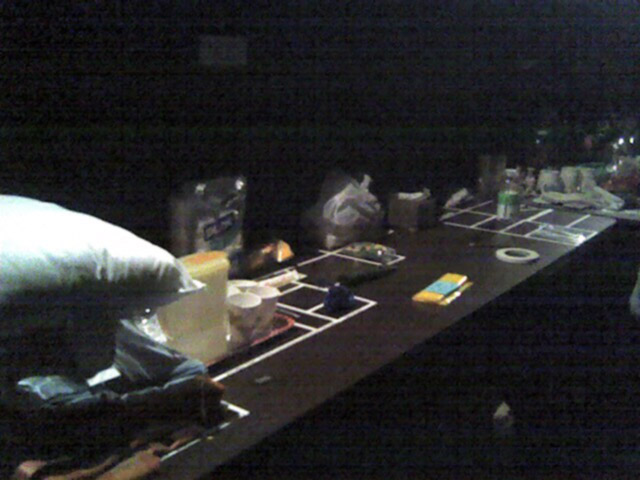
After walking through the set I went in search of my prop table, which I quickly found in the very spacious upstage area. It was more like a prop buffet about 12 ft. long — already set up and loosely categorized by our prop mistress. That rocked! I set up a little office for myself by adding an adjoining table, and went to work with a roll of white spike tape and a Sharpie, marking the table for the location of the props. I amused myself with props for about an hour-and-a-half as the actors arrived and did a costume parade on the set. Then the worklights were taken out and I realized the escape stairs and platforms were pretty darn dark, so I went to work glow taping all the edges and steps.

The rest of the day was spent on a spacing rehearsal, with the lighting designer building cues around us, and with sound cues. We reached the end of the day and the crew called it quits literally three seconds before one of my biggest cues in the show. I was rather disappointed about that.

It’s been a nice treat that our day off fell today so we can all rest up for the week, but I’m looking forward to continuing tomorrow morning.


April 25, 2007

#1 Reason to Be Equity: There Will Never Be a Video Allowing the Entire Internet to Second-Guess My Work

I call this: theatre — Posted by KP @ 5:59 am

An incident happened last week at monologuist Mike Daisey’s show in Boston in which a high school group of about 80 people (in a 300-seat theatre) got up and walked out in the middle of his show. Apparently they were a Christian group and were offended by the language in the show (despite apparently having been told it had adult language when they bought their tickets). If you want the full story, it’s on his blog (with video of the whole thing, too!)

But that’s not really my point. There’s been some wondering in the online communities about whether an event of this magnitude might have been staged to drum up publicity for an otherwise largely unknown show. One thing in particular that is used as evidence is that the house lights were brought up right away when the people started to leave. Some have pointed to this as an indication that the stage manager was prepared for what was about to happen. I don’t really have a strong opinion about whether it was staged, but from the moment I saw the video I was interested in the decision to bring up the house lights, simply because I wasn’t sure what I would do if that happened to me.

My final decision is that if I had no idea why they were leaving, I probably would have brought up the lights too, because if a third of the house suddenly got up and rushed out, I would assume it was due to some sort of danger, not because an actor said the word “fuck.” Whatever it was, it would probably benefit everyone to be able to see, and the performance would have to be stopped anyway due to whatever dangerous situation existed. But if the booth was open to the house and I could hear some sort of rumblings of complaints about the material and had a good idea of why they were leaving, they would get no help from me in finding their way out, and I would not turn on the house lights unless told to do so by the house manager or the performer himself. So if this get-up-and-walk-out thing was as sudden as it appears to have been, I’m going to say the stage manager had no idea what was happening, and probably assumed there was a good reason to bring up the house lights immediately.


April 22, 2007

Further Adventures with the Rubik’s Cube

I call this: theatre — Posted by KP @ 6:34 pm

So since my first day with the Rubik’s Cube which concluded with me spending two hours at home fixing it, I think I have had a total of one day of rehearsal which did not involve me having to solve the cube at least once. Many days I have had to do it two or three times. I have saved the site I use to help me to my Treo’s web browser, so I can call it up during rehearsal to fix the cube as we work. Since my duties right now basically consist of taking prop notes and being on book, any time we stop to talk about blocking or character work, I use that time to follow the directions and fiddle with the cube. Of course viewing a graphically-intensive page on such a small screen can get confusing, especially when the diagrams to show the moves don’t all fit on the screen at once. I have hopelessly screwed up an almost-solved cube numerous times because I got distracted at some point and obviously did something wrong.

Today I realized the need for a cheat sheet, and I made a crude pencil one during rehearsal, which worked very well. Tonight I arranged the graphics from that site into a concise page, which should eliminate a lot of the delays in restoring the cube during rehearsal.

The actor who uses the cube in the show has really taken to it, and perhaps due to the fact that he spends a lot of rehearsal sitting around, has come up with a good system to screw up the cube enough that it appears to be sufficiently jumbled-up, but he can solve it in six moves without getting confused. Unfortunately our cube is rather cheap and gets jammed a lot — it’s quite comical that when he practices he solves the cube easily while delivering his dialogue, but as soon as he gets in front of the director, the cube refuses to work smoothly and makes the whole endeavor look like a bad idea. But we’re confident we’ll get it to work. I’ve been trying to break the cube in for him during rehearsals when he’s not around. Which is how I got it screwed up today — the first time. The second time was because my PSM was messing with it and handed it to me saying, “Here, see if you can figure it out — it’s only two moves away.” I failed. Miserably.

I hate doing props, but one nice thing about it is that you can pick up really random skills.


April 17, 2007

Prop Master’s Nightmare — The Rubik’s Cube

I call this: theatre — Posted by KP @ 7:01 pm

So my show has a Rubik’s Cube in it. And it needs to be solvable on stage by the actor in just a few turns. How exactly this is going to be set up so it works every night, we haven’t quite figured out yet. My instinct is to let the actor take it home and play with it, and figure out what works best for him. There’s been some concern about the possibility of the Rubik’s Cube getting hopelessly mixed up, but I assured everyone that in the unlikely event something happened to it, there are sites on the internet that show you the moves necessary to solve it. No big deal.


So today… the Cube wasn’t needed in rehearsal, so it sat on the stage management desk the entire day, and to stay sane while being on-book, I began spinning the cube, always in one direction, unless I was looking right at it, at which point I would spin it once the other way, and then quickly restore it.

After four hours of safe operation, I started to get a little too daring, and you can guess what happened. Long story short, if you need to solve a Rubik’s Cube, this site is the best I found for simple instructions and illustrations. But I will never get back the last two hours of my life, and I leave you with this bit of wisdom: the easiest way to solve a Rubik’s Cube is not to mess with it in the first place!


April 10, 2007

Pimp Your Mac with Theatre-Related Icons

I call this: computers,mac,theatre — Posted by KP @ 9:09 pm

If you’re a visually-oriented Mac user like me, perhaps you like to make your frequently-used application and folder icons distinctive so that you know at a glance what you’re looking at. I’ve downloaded lots of icons from the web, but often I find there’s not one appropriate for my needs. Which makes sense, since nobody (else) bothers making icons for stage managers, or bearing the logo of some obscure new play or musical nobody has heard of. So I’ve taken to making my own to make things easier to find.

So here are some of my favorites, available for download in two packages.

Package #1 – Basic Folder Icons

Only two here. One is my basic Stage Management folder. I keep this one in my Finder sidebar, so I have a quick link to all of my subfolders of show files and general paperwork. One of those subfolders is my Equity folder, which holds the PDFs of the rulebooks for all the contracts I’ve worked under. Very handy to have around.

Package #2 – Show Folder Icons

When I’m doing a show, the folder for that show is one of the more important items in my computer, usually making its way into my sidebar for the duration of the production. As such, I like to have a nice, very noticeable icon (preferably that doesn’t look anything like the icons for other shows I’m currently working on.) This is a collection of folders for shows I’ve done or am currently working on (only the one’s you’ll ever hear of). Sorry the one for The Fantasticks has that weird orange border. Never quite figured out why it was doing that. Of course the logos are copyright of their respective shows — I wish they were mine, I’d be a millionaire.

The shows included are: 42nd Street, Crazy for You, Carousel, The Fantasticks, The King and I, The Phantom of the Opera, Thoroughly Modern Millie, Singin’ in the Rain, The Sound of Music, and The Will Rogers Follies.

Oh, and there’s also my icon for Adium (which is a highly customizable instant messenger app, if you’ve never tried it). It’s the Adium mascot, Adiumy, as a stage manager/tech person, with a cue light overhead to indicate Available, Away, Idle, Invisible, etc. Yeah, I know it doesn’t make any logical sense that the same lightbulb keeps changing colors. I really did want to have all the bulbs visible, cause I’m a perfectionist, but 128 pixels is 128 pixels, and it has to look better much smaller than that.

How It’s Done
To make simple icons, I use a shareware app called Can Combine Icons, which is incredibly easy to use if you just want to combine two icons or images, and it comes with a full library of standard Mac icon images to get started with. Some simple image manipulation and color changing is also possible, which works great when you want the folder color to match whatever else you’re putting on it. It’s only 10 bucks, and for how much I use it, and how you can create a professional-looking icon in literally seconds, it’s well worth it. I should caution though, that it doesn’t seem to have been updated in a long time, and I’m not 100% sure of its Intel-compatibility (though I can’t see why it should be a problem), and some comments on VersionTracker indicate the developer may be slow to generate registration codes now. But it’s one of the best apps I’ve ever purchased, so I can’t complain. And of course there is a free trial.

To change an icon for an application or folder, click on whatever icon you want to use (perhaps one you’ve downloaded here), and press command-i. This will open the item info window. In the upper left corner is an image of the current icon. If you click on that, it gets highlighted. Press command-c to copy the image. Then do command-i on whatever item you want to apply the first icon to, click on the icon image in the resulting info window, and press command-v to paste the icon. If you want to go back to the default icon for that item, command-x for “cut” will remove whatever custom icon you’ve added.


What I’m Working On

I call this: theatre — Posted by KP @ 8:00 pm

Updates have been a little light for the last week, partially because nothing particularly interesting has happened, and partially because I’ve been busy with work, on a show that is quite interesting itself.

Now that we’ve got some digital publicity materials available, the time has come for me to plug my show. It’s a new play produced by The Working Theatre (who hold a special place in my heart since I got my Equity card with them). It’s called Back from the Front, by Lynn Rosen. I’m not the best press rep, so let me quote from the show’s publicity material:

Back From the Front paints an absurd picture of America at war, a hilarious and finally tragic portrait of a family coming apart at the seams. When a government liaison announces to the Walker family on national TV that their son, Robbie, who’s been mysteriously inaccessible since his helicopter was shot down in Iraq, will be delivered home for Thanksgiving, they are overjoyed. But when a strange young man in uniform arrives on their door-step, they go to record depths of denial to avoid the unbearable prospect of loss.

Yes, it’s a farce about the possible death of a young man in Iraq. When this job was pitched to me, my first reaction was that it would have to be some amazing writing, or else it was going to be really bad. The first read-through removed all my doubts — it actually works. It’s hysterically funny, and at the same time tragic and moving. And we have a great director and cast, so I can’t wait to see the full production, and hear how it plays with an audience.

The set design has me particularly excited, but I don’t want to say much, as all the really cool things about it are meant to be surprises. I didn’t even mind spending two hours taping it out on the floor this morning — I was just so happy to see it come to life in actual size, if only in the form of yellow lines on the rehearsal room floor.

It plays at the Riverside Theatre at Riverside Church (where I did my first professional show, so that’s another nice homecoming), throughout May.


March 30, 2007

Creating a wireless network for the rehearsal room

I call this: computers,mac,theatre — Posted by KP @ 11:37 pm

I’m about to start rehearsals for a new show, which has got me thinking about getting all my goodies set up to take with me to rehearsal. One of my favorite ways of making things more efficient in the rehearsal room is to set up my own wireless network for the use of the stage management team, creative team, or even the actors who want to use a laptop or other wireless device on their breaks.

Unfortunately, below a certain level, most theatres and rehearsal spaces don’t offer much in the way of internet access. If there’s wi-fi, it’s probably by accident, that the hotel across the street might has an open network or something. And it seems to be one of Murphy’s Laws that the signal never reaches to the area of the room where you have to set up your table. It’s even hard to find a phone line (or one you have access to) to use dial-up. Most of the time I use my cell phone as a modem, and connect by Bluetooth from my laptop. This gives speeds about the same as dial-up, but also wears down my phone’s battery, and can sometimes interfere with incoming calls.

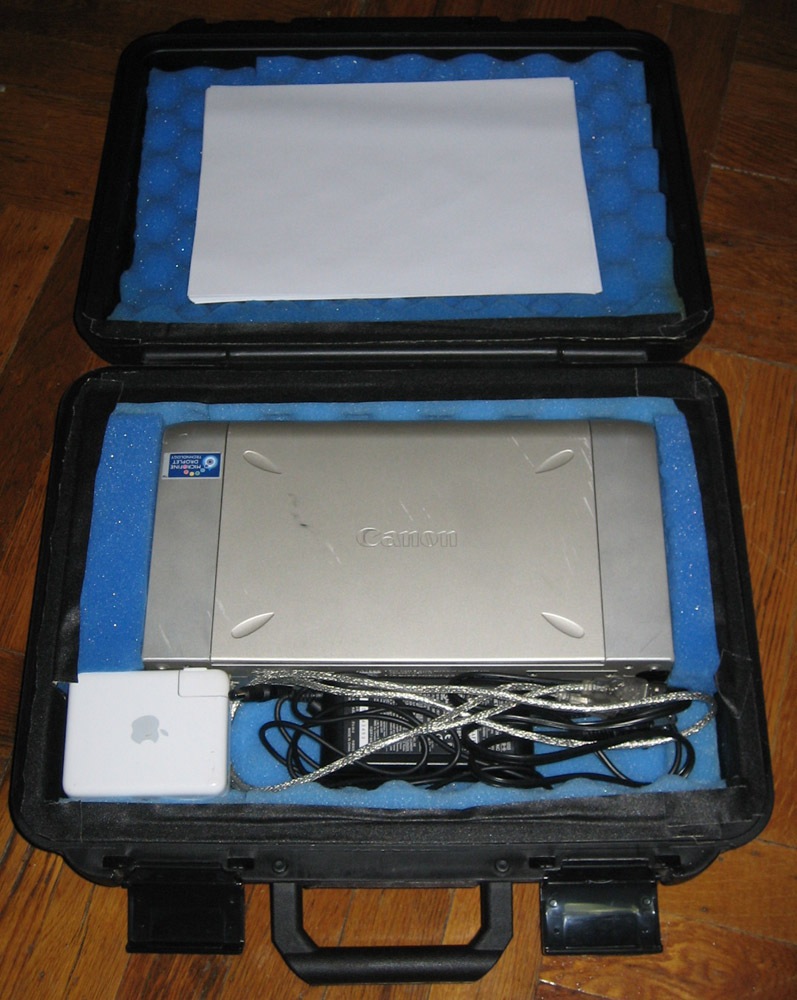
Should I be lucky enough to find an ethernet connection somewhere in the building, that’s where I will set up my network. The key piece of equipment here is Apple’s Airport Express router. It’s not the most fully-featured router, but it’s tiny! At just a little bigger than the power brick of a Mac laptop, I can shove it in my bag — or as I usually prefer, in my printer carrying case — and forget it’s there until I need it. I also carry a retractable ethernet cable which likewise stays out of the way until it’s needed.

In a perfect world, the place I like to set up the router and printer is:

  • not in the rehearsal room, where the printer will make annoying printer noises
  • close enough to get a strong wireless signal through the wall (~50 ft.)
  • in a location occupied only by people who won’t steal stuff

Once I’ve found my location, I plug in the router and printer. Finding two outlets, one of which is big enough to fit the brick of the router, is sometimes the hardest part — stealing a power strip from somewhere is often the result. If the ethernet connection is a jack, I use my own cable to connect to the router. Then with the USB cable I carry, connect the printer to the router. The printer I use is the Canon i70, which is no longer made, but the i90 is the current equivalent. The only thing I really dislike about it is that it doesn’t have one of those little slots for a computer lock to be inserted. I leave the printer lying around unsupervised much more often than my computer, and yet there’s no way to secure it.

So now that everything is plugged in, it’s time to set up the software. Using the Airport Admin Utility, I create a network, which I usually call something very simple and easy for other people to remember. I always create a closed network, meaning that it won’t show up to random people as an available network. Each person has to know the name of the network and type it in manually. I generally don’t bother with encryption, as I have had more headaches trying to get it to work for everyone, especially when some people are on PCs or other devices. If I really want security I will set it to allow only the hardware that I specify, which means every time I add a new person having to get the MAC address of their computer or mobile device. If all has gone well, the router will be displaying its happy green light, meaning it has an internet connection, and everyone should be able to access it for internet and printing.

Being able to give reliable internet access to everyone in the theatre or rehearsal room makes everything much easier. The last two shows that I was PSM for were workshops of musicals in development. Every day, every hour, sometimes every half hour, there were new pages of text, new songs, new arrangements e-mailed from the copyist, and all of it had to be distributed to be worked on NOW. The musical director would decide to change the key of a song, the composer would transpose it on his Powerbook in Finale, e-mail me a new PDF, and I’d send it to the printer. The whole process could take less than five minutes, and nobody had to get up from their chair, except to go out to the lobby, grab the pages from in front of the printer, and hand them out. Theoretically the composer could have even sent the file to the printer himself, although I never bothered with the few seconds it would have taken to add the printer for anyone besides my assistant, and I would have needed the PDF for my records anyway.

Even in situations where internet access is not available, just having the printer on the network can be a big help. Being able to send print jobs out of the room and have them waiting whenever I feel like picking them up is great for spaces where the noise of the printer is too distracting, not to mention the ability to let others also use it. And the best part for someone like me who often works in many different locations and is not always given storage space, is that everything is very easy to carry. I bought an unfinished carrying case from the Container Store, and shaped the foam padding to hold my printer securely, with a little extra room for its cables and the Airport Express. Then I throw some blank paper on top of it all.


March 22, 2007

My Life in Theatre

I call this: theatre — Posted by KP @ 5:23 pm

I’m a stage manager. I work almost every day, but I don’t exactly have a “job,” per se. I sub on a few shows, on Broadway and Off-, and I’m often doing other events or short shows like workshops and such. I much prefer going to the same place every day and having some kind of consistent experience, but as long as I make a living I guess it’s OK. It just leads to a really long answer when people say, “So what are you working on?”

I generally don’t know what I’m doing two days from now. I don’t even attempt to remember, because it’s never a predictable schedule. My Treo 650 runs my entire life. I honestly wouldn’t know where to go tomorrow. That’s why multiple backups are important. A lot of times I don’t know where I’m going to be in two days because I actually don’t have anything booked. Sometimes my schedule fills up really fast and I have to turn stuff down, and other times I’ll find myself sitting at home for days on end, or getting a call at 10AM to come in at 12:30 for a matinée. I get frustrated when I go more than a few weeks without a day off, but then when I have them I tend to think of them as “days I am lacking employment” rather than something earned. This is another reason I like having a steady show that pays me a living wage — I get one day off a week, and I don’t have to feel guilty if I don’t book other work on that day.

Last fall I worked in an office for the first time in my life, as the production coordinator for the musical Bingo in Ft. Lauderdale. It was fun at first having a desk and my own phone extension and stuff, but the whole office existence is not really for me — especially the getting up at 8AM every day! I worked in the general management office, where my job was really more like long-distance stage management, except without the fun parts of actually doing the show, or getting to go to Florida. I fell in love with the show while doing the Off-Broadway production, and it was great to see it expanding across the country, and to work with many of the same people again. I recently did a little bit of part-time work on the Chicago production, which is currently in previews at the Apollo Theatre.

I have a number of things in the works for the next few months, so many in fact that I’m not really sure which will end up working out, but it should result in a few “real” jobs, which will be nice.


« Newer Posts