HOME

September 26, 2009

Inventing Avi

I call this: theatre — Posted by KP @ 12:59 pm

I guess it’s about time I talked about my current show. My fall plans were kind of up in the air until the last minute, with a number of possibilities floating around, but I ended up ASM-ing a new Off-Broadway play called Inventing Avi, produced by the Abingdon Theatre Company.

I’m assisting my good friend Josh, which is a always a lot of fun. Josh assured me that if I took the job, the play would keep me laughing, and I haven’t been disappointed. The play is very funny, and our cast of six is amazingly talented. I have to call them out individually: Alix Korey, Stanley Bahorek, Emily Zacharias, Juri Henley-Cohn, Havilah Brewster and Lori Gardner. From day one they have been hysterical, and they have an amazing gift for making a scene laugh-out-loud funny no matter how many times we’ve gone over it in the rehearsal room.

Josh and I have also been working on paperwork a lot. Stay tuned for more details on that.


September 18, 2009

Facebook as a Business Tool

I call this: random,theatre — Posted by KP @ 2:44 am

I know there are Facebook haters. People who think that anybody who uses social networking sites is a waste of oxygen and must have the IQ of a gnat. Those people are stupid. But they generally don’t know it, otherwise they would know they are not one who should be scoffing at the intelligence of gnats. This post is one small story in disproving the assertion that Facebook is useless.

First there are those who believe that social networking actually makes us less social. For some people who are very naturally social, I suppose this may be true. Myself, I am extremely antisocial. I think I’m a very pleasant person and well-liked by the people in my life, but though I have many friendly acquaintances, I have a lot of trouble forming close friendships. As a result, I lose touch with people the moment they leave my life in whatever context I knew them (which in this business can mean a new job every few weeks or months.) I tend to assume (maybe neurotically) that nobody really wants to hear from me that badly, so as a result I never contact anyone. But Facebook is a way of saying hi when even an email feels too intrusive. If someone is reading my message on Facebook they are there because they want to get random messages from people like me, and so I feel no anxiety about making contact with them. It also keeps me up to date with what other people are doing, which opens up ideas of other things we might have in common or be able to do together. Which brings me to my point.

I have a show in rehearsal right now. I have been Facebook friends with our production manager since we did a show together about a year and a half ago. One day last week, his status was about how he was looking for an Express programmer for certain dates (pretty clearly our tech). On that same day, another friend, who was the venue tech director for a show I did at NYMF last year, had as her status “Amy really needs to find employment,” or something to that effect. I wrote Amy a message and asked if she could program an Express and was willing to work a short-term job for undoubtedly crappy pay. She was. Cut to today, and Amy has been hired as the programmer for our tech. Now she has a job, we found a programmer, and maybe she’ll get future work now as a result of making these new connections. And all this was made possible very easily, when there’s no way I would have known about either her need for work, or our lack of luck finding a programmer if we had to rely on talking to people individually to find out what’s going on in each other’s lives.

And on top of that, since the job in question happened to be the show I’m working on, I will actually get to see her in real life, proving that Facebook does not cause you to see your friends in person less! Someday I’ll give you my rant about why text messaging is more useful than phone calls.


September 3, 2009

Thoughts on the Deck

I call this: theatre — Posted by KP @ 2:16 am

Late this afternoon I was doing some crap on my computer when the phone rang. My reaction was something like, “Oh what now?” for about 2 seconds until I actually looked at the phone and saw the happy little mask and text saying “Phantom SM Office.” Cautiously optimistic, I answered. At 4:00 I was put on hold for possibly doing the show tonight. I immediately started getting ready because I haven’t called the show in six months, and haven’t done the deck in probably a year, and had no idea where I might find black pants, black shoes, flashlights, deck notes, etc. A half hour later I got the confirmation call that I would be going in, though no specifics if I would be decking or calling. I decided to assume that I would be decking, as I felt more prepared to call.

I spent the remaining time at home walking through the deck track in my head (while I review periodically to remain ready to call at all times when I’m in town, I tend to completely ignore the deck until the day I get booked and then do a quick refresher).

I arrived at the theatre and found out I would be decking, which was good. Craig suggested I look around. I made a meandering path around the stage and trap room, saying hello to the stagehands doing their preset, making sure nothing had been moved since I’d been gone. Everything looked exactly the same. The same, but really, really clean. I don’t remember the place being a mess in the past, but I was really struck by how clean everything was. The white walls backstage were white, not white and covered in 20 years of grime. They looked like they had been washed last week. As I was mentioning how tidy everything looked to the head carp, he said they were due for a paint call on the deck soon. Now the deck has been painted every 3 months for the last 22 years. When it’s just been painted, it looks like a glossy black mirror. When it needs a painting it looks like a dull gray pitted mess, with large sweeping scrape marks showing where all the scenery gets rolled across it, where chandeliers crash on it, etc. It looked like it had been painted maybe a week or two earlier. I was very impressed.

Anyway, doing the show was a lot of fun. No one can quite remember when the last time I decked was (though we have a database to answer questions just like that, and nobody thought to look it up), but it’s possibly been over a year. Whenever it was, I haven’t decked any other show since then either, so it was kind of a weird experience.

Since then, I’ve been very used to sitting at my comfy calling desk (including at Phantom) and just watching a show happen around me. Being away so long has reminded me of the differences of doing the deck.

First of all, by intermission I was getting kind of claustrophobic. The Phantom stage management office is always crammed with way more people than it should be, but even doing the show itself, there were just so many people everywhere. Tons of stagehands, dressers, hairdressers, a decent number of actors, there are just people everywhere. Personal space is often very strictly regulated, like your track is allotted this square foot-and-a-half for this scene change and that’s where you go. People often say that the backstage traffic on the show is far more complex and exact than the onstage choreography, and it’s true. It’s the main reason I worry about doing the deck. Calling the show is kind of a solitary pursuit in some ways. You interact with other people, but basically you know what you’re trying to do, which is to put on this show, and you have all these cues to work with, and you react to what other people are doing, but basically your butt is in a chair and you make things happen with your voice and flipping some switches that turn 10-watt light bulbs on and off elsewhere in the theatre.

Doing the deck is kind of like the difference between playing a video game on your TV or computer, and playing paintball or laser tag. You are IN the game, and you’re right there, on stage, above the stage, just off stage (Monsieur Reyer pointed and screamed at me tonight, “This is a disgrace! Who is this!? She’s back!” during the chaos in Hannibal). You have to fit yourself in and out of the backstage ballet, and even if it’s been a year and you don’t know half of the people around you, you need to hit your allotted spot, not have your elbow sticking out, or be a half-step out of your track, because that’s probably somebody else’s space.

Calling the show, my focus is ultimately on what the audience sees. I feel I’m responsible for reproducing the stagecraft that people have traveled from across the world to see. I am also concerned about supporting the actors with a well-paced show, and keeping everyone safe, but ultimately all of that is a subset of calling a perfect show for the audience.

Backstage, I don’t really care what the audience sees. I mean I care that we don’t screw up, but I don’t think about it during the show. I’m not really aware of them, or of the story being told, or who cries when the Phantom is left alone. All I can see is that we are all like little hamsters in a giant machine, and I am for some reason tasked with being ultimately responsible that all the hamsters get where they are going, and nobody gets crushed by the machine, and the machine doesn’t get jammed up, and performs its functions perfectly. It’s really quite a responsibility when you step back and look at it from an outside perspective, as I have from being away so long. Just being ready to do an average performance is not that big of a deal. Having the level of comfort that I could make the right decisions in the event of a serious problem is what causes most of the stress. Everything that happens, I am thinking about the worst thing that could possibly happen and have my responses planned.

The one thing I enjoy about the deck is the idea of traveling around and seeing everyone. It’s a much more social way to do the show, especially if you’ve been gone a while. As you do your track you pass by and interact with various actors and crew, and have either a few seconds or a few minutes to say hello and catch up. Sometimes it means you meet new people. Tonight I reached the point in Hannibal that is generally “the spot where you say hello to Madame Giry.” Except we had never met. So we shook hands and introduced ourselves.

Then there are the other random things that I never thought too much about — like you’re on stage, in the dark, and five actors are about to climb down 20ft on a giant metal fence. They attach their safety cables in the dark. You check their cables — twice — in the dark, using only the sense of touch. Once a year.

The general idea of darkness is something I had lost appreciation for. The story goes that when the show was in tech Hal Prince had a policy that the stagehands were not to use any flashlights. The show is very dark, and he didn’t want any spill from offstage breaking the illusion. Nowadays flashlights are used occasionally, but the general theme remains that most of the time, people have just adapted to doing everything they need to do with very little light. I was looking around during Music of the Night, and realized, what I always knew but had never thought of — there are no running lights backstage. The prop tables have the teeniest, tiniest accent lighting (which is fairly new) highlighting just a few items, mostly the detailed ones like the letters.

The only thing that might be considered light for the purposes of seeing where you’re going are the ropelights that run up the ladders on each side of the travelator, the ropelight on the sides of the bridge that spans the traproom, allowing a crossover through the basement (which is good because the bridge has a little ramp at either end), and the ropelight on the angel bridge which is really dark, really narrow, and really high in the air. There’s a little bit of glow from other areas that are lit with normal lighting, like the hallways and the fly floor, against which you can see more things, and during much of Act II there are full-blown worklights on upstage for the big transformation from the Masquerade stairs to the mausoleum, but for much of the show, the only backstage light is spill from the stage. Some edges of things not visible from the audience are painted bright white, but even that is fairly recent.

It’s quite impressive how well everyone gets around in such a crowded environment, in the dark. Which maybe is why I tend to be incredulous when people ask for more running lights on other shows. I was brought up to learn where things are in the light, and to use that knowledge not to run into them in the dark. Anyway, I have a newfound appreciation of the special navigational skills of the Phantom cast and crew.

And P.S. watching Raoul jump in that trap when there’s so much fog that I can’t see the trap myself is always the most stomach-churning thing ever! I mean I know he won’t jump if he can’t see all the landing lights, but I always like to catch a glimpse of the hole myself and verify that it’s fully open.

Well thanks for reading. I know this post is kind of rambling, but I was filled with many random moments of discovery tonight and just wanted to share, cause if I waited to make a really carefully constructed post I would completely lose the point.


August 29, 2009

Tales from the Left-Hand Page: Phantom Edition

I call this: theatre — Posted by KP @ 1:25 pm

UPDATED! Now featuring images of the cartoons and photos mentioned, by reader request!

Most stage managers like to jot down funny things that happen in their calling scripts — usually funny quotes or a particularly hysterical mis-reading of a line. I realized that some of these are worth sharing.
I can’t decide if this deserves to be its own page on the website or just a blog post. Maybe when I collect some more it will be upgraded.

Names changed or omitted where necessary to protect the guilty.

First, let’s start with a complete set, from my Phantom calling script:

————

On the title page of the script (which is I think the only script I’ve ever used where I bothered to keep the title page), I have written some wise words of wisdom, from one of Phantom’s long-time stage managers:

“‘Oh shit!’ means it’s going to cost money.”

This arose out of a discussion we were having about stage managers who have a habit of making exclamations on headset for simple things like missed light cues that tended to freak out the crew unnecessarily. I thought this was a very succinct way of summing up at what level of mistake it’s appropriate to say, “Oh shit!”

————–

The script begins with a cartoon.  Phantom has a long history of displaying a cartoon (almost always from The New Yorker) on the In/Out sheet for every performance, in the hopes that it will attract more people to actually read the callboard, and the In/Out sheet in particular.  It seems to work, because the cartoon is kind of a big deal.  It’s the first thing most people see when they show up at the theatre, and the relative funniness or not-funniness of the cartoon will be debated and commented on for the rest of the performance. Being the stage manager who gets to choose the cartoon for the day is an honor and a responsibility that I always take very seriously.   The first cartoon in my book is on the page facing the first page of the actual script, next to all the check-in lists.   It depicts a rather serious-looking gentleman sitting behind a window labled “Complaints,” holding a violin and bow, obviously ready to play for anyone who should come to him with a complaint.  This cartoon holds a place of honor on the main page because I chose it for In/Out sheet sometime back in early 2004, and when the show was over, presented it to Barbara-Mae Phillips, who was at the time the ASM, and had a dry sense of humor that seemed perfect for that cartoon.  When Barbara-Mae passed away later that year, I found the cartoon as we were clearing off her bulletin board in the office, and decided it deserved to be kept alive in my script, on the first page where everyone could see it.  To this day it still gets a chuckle or a comment from actors waiting next to me at places.
complaints
————-

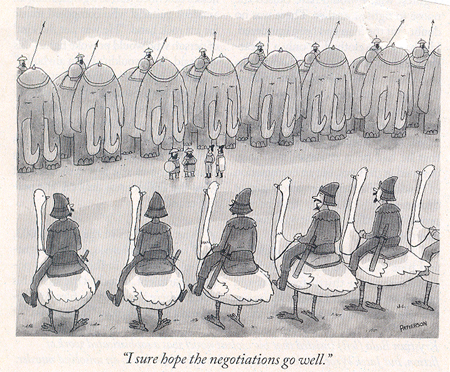
The next entry in the book is also a cartoon.  This one is located in the “Hannibal” section.  It shows a fearsome army of elephant-mounted soldiers facing a decidedly less-fearsome army who appear to be riding ostriches.  In between the armies, their leaders are obviously having a conference.  One of the ostrich-riders in the foreground says to the other, “I sure hope the negotiations go well.”  I was pleased to discover this one one day while picking out the cartoon of the day, as it’s always nice to find one that in some way references the show.
hannibal
————–

OK, now we have a show quote.  Later in the Hannibal scene, Madame Giry is talking about the Phantom’s demands for a salary, and is supposed to say, “Monsieur le Vicomte paid him twenty thousand francs a month.”

Well one night, a certain Madame Giry said:
“Monsieur le Vicomte… gave to him… twenty..five…..  thousand…. dollars..a year.”

It was one of those things where every single person onstage had to turn upstage to hide their reaction.  I was very fortunate to have been out in the house with a notepad, and started writing before she was even done, so I got it down word-for-word.

————–

Later on the same page I have a stage management quote.  This comes from a performance that was given during the Republican National Convention in August 2004.  The RNC bought out a performance of Phantom, and throughout the week we had other delegates coming to the show.  The whole thing was surrounded by increased security and other preparations that just made it a big stressful event everyone wanted to be over.  Early in the big RNC performance, the calling stage manager said,

“Warning Electrics 28 through Thursday”

It’s supposed to be 28 through 30, but clearly everybody subconsciously wanted to get to Thursday, when everything would be over!  So there was a great laugh about that on headset.

—————-

At the end of the Journey (the title song), I have a quote from the PSM, Craig Jacobs:

“You call a great show.  You call lousy fog.”

I don’t remember the particulars, but I think Craig was returning backstage after watching the Journey from the house, and we must have had an especially noticeable lack of dry ice coverage that night. The joke, of course, is that although there are techniques, in 22 years nobody has been able to come up with a reliable way to make the fog look good every night, so it’s the one aspect of the show nobody can really control.

—————-

On the next page, in the middle of “Music of the Night,” I have pasted a picture that used to be in the Playbill, of Howard McGillin and Rebecca Pitcher, in the traditional “Music of the Night” pose, except that Howard’s hand is a little lower than usual, over Rebecca’s nether regions.  When someone of great authority came to the show and noticed it, it was promptly pulled from the Playbill.  Naturally I grabbed one of the last Playbills and pasted it in my book with the word “HOO-HA!!!” written over it in bubble letters, as that was the technical term that was used when the problem was described to me.
hooha
Incidentally, this shot takes a really, really long time to take at a photo call. I suppose partially it’s due to the fact that it’s one of the more iconic images and probably most likely to be published, so extra care is given to it, but also the quality of the fog in the background is very hard to get just right, the height of the candelabras in the back can be adjusted in small increments depending on the height and exact pose of the actors, etc. I once worked a photo call where this shot alone took 2 hours and the theatre had to have all the exit doors and emergency vents in the roof opened to clear all the smoke before the show that night. In fact, it’s entirely possible it was the very photo above, as I do recall it being Howard and Rebecca. After the ordeal we went through to get the atmosphere just right, I’m not really surprised no one noticed his hand was over her hoo-ha.

—————

Now we have a couple Manager quotes:

“A disaster beyond your exaggeration will recur.”
(instead of “a disaster beyond your imagination will occur.”)

“Miss Daae will be playing the playboy!”
(instead of pageboy)

—————-

In the section known as “Il Muto Panic” which leads from the Il Muto ballet into the rooftop scene, I have this quote, from one of our stage managers:

“The absence of disaster is a success.”

It’s dated from early on in my time calling the show, and at first I assumed I must have made a slight delay in Il Muto panic, as I struggled a bit with the timing the first couple times I called the show.  Then I pulled out my handy printout from the database of all the performances I’ve called (which is really handy to have around when someone says, “I saw the show on _____” or some video turns up on YouTube with the date it was recorded).  The date of that quote was my fourth performance, which is one in which we had a big automation problem earlier in the show, which looked less pretty than usual, but avoided crashing any scenery into anything or anyone.   I can only imagine that quote came from a later discussion about what had happened earlier, but I have no idea why I would have written it on a page where I would normally be so busy.

——————

This one is from just the other night, from the mausoleum scene:

“You can’t make her love by winning her your prisoner!”
(the line is, “You can’t win her love by making her your prisoner.”)

——————

This one is written during “Point of No Return,” but is labled thusly:

INTERMISSION:
Me: “Are the [reverse] tabs working?”
Bethe: “…Yes. Good luck!”

I’m sure they worked fine, as I’ve only done that sequence without them once, and we knew in advance they were broken. But clearly something was up that night that led to the less-than-certainty of an uneventful Don Juan Panic.

——————


August 23, 2009

The Tale of the Thirsty Flyman

I call this: summer stock,theatre — Posted by KP @ 9:53 am

Last night our flyman was enjoying a bottle of Gatorade during a scene. As he was drinking it, he looked for a place to set it down between sips, and settled on the only flat surface in his vicinity, on top of the counterweight bricks on the line he would next be flying. The thing is, he never went back for another sip until after the scene change, when he looks for his bottle, and realizes it’s now somewhere up in the vicinity of the grid and will be staying there for about ten minutes. Thankfully it didn’t spill on the way up or on the way down.

I think this has to be the theatrical equivalent of driving away with your coffee on the roof of your car.


August 17, 2009

Fun with the ETC Ion

I call this: mac,summer stock,theatre — Posted by KP @ 11:12 am

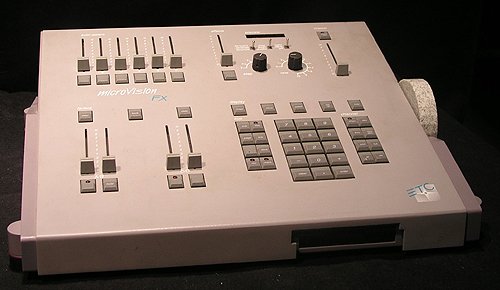
Reagle’s regular light board is the ETC Microvision FX, an example of which is shown here.
MicroVisionFX
It’s ancient. It usually works OK, when it doesn’t double-go, but for anything complicated, like color scrollers or moving lights, a newer console needs to be rented. La Cage is just that kind of show.

This time around we got the ETC Ion, shown here (except we don’t have the one with the row of faders on top):
ion

It’s very cool. It saves the show onto a thumb drive instead of floppy disk, and so forth. I haven’t had much time to learn how to use it (I can barely bring a cue up), but while we were in tech our lighting designer invited me to play with the scrollers. It was definitely the highlight of tech. There are a couple different ways the board can help you choose color. There is sort of a color swatch screen that shows you the gel numbers and you click on the one you want. The dials at the top can also be spun to change color, saturation, etc. But the one I got to play with was the color wheel.

Since I’ve been doing a lot of web design and graphics lately, I have been kind of obsessed with color. So when I saw that the board had a color wheel, the same as you’d find in Photoshop or wherever, and you can click anywhere on it and it will put that color onstage, I thought that was incredibly cool. Of course the specificity of the color it can produce is limited by the variety of gels you have in your scroller, but even in my random clicking I was able to get it to look pretty much like I wanted.

I made a short video to demonstrate this feature. Unfortunately the color wheel got pretty much washed out on the video, so I didn’t spend any time looking at the intricate differences in color since you can’t see exactly what the mouse is pointing at, but you get the idea.

Also, as a side note, I shot this video with the iPhone 3GS, and edited it with iMovie ’09, which is the first time I’ve successfully created a movie with the new iMovie format without having to stop before I smashed my computer. Even with something so simple I was frustrated by stuff that I apparently couldn’t do, but it at least gives me hope that I don’t have to hang on to iMovie ’06 forever just to get anything done. Just the ability to upload to Youtube without worrying about formats was worth it.


August 9, 2009

La Cage Tech

I call this: summer stock,theatre — Posted by KP @ 11:49 am

We are in our second day of tech for La Cage. Since Twitter has been suffering from a DoS attack, there is no techtweet this time.

We teched the first act during the first 10-out-of-12 hour day. This is a new show for Reagle, so we’re feeling our way a little more than usual but overall it’s not going that much more slowly than a more familiar show.

The cast is completely comfortable with the show, which eases a lot of our stress about the final outcome. The show is quite busy technically — there are some numbers where finding a place to give warnings was tricky. It’s become something of a joke in certain parts of the show, for the TD to say, “Karen can you find a place to give us a warning…” and I immediately say, “No.”

We’re using color scrollers for this show, so our little Microvision from 1987 B.C. needs to be replaced whenever that happens. We’ve got a rented Ion, which I’ve never used before. It’s basically the very modern version of the size of the Microvision. During a break yesterday I was invited to play with the scrollers. I was handed a mouse and pointed at a color wheel on one of the screens, like you would find in Photoshop or whatever. I was told to click anywhere on the color wheel. Instantly the entire stage changed to that color. I played with it for a good five minutes just watching how many different shades I could make. It may be the coolest thing ever.


August 7, 2009

The Sorry Jar

I call this: computers,gaming,theatre — Posted by KP @ 11:04 am

In our rehearsal room for La Cage, we have some very apologetic people. So much so, in fact, that our director decided early on that every time someone says “I’m sorry,” they owe him five cents. Naturally, being stage managers, Paul and I were put in charge of keeping track of the debt.

BACKSTORY:
I have been working more with Google Spreadsheets lately, which I have grown to love as a result of my involvement with the game Battleground Europe. As a member of the Axis high command, I was first introduced to Google Docs because all the data that keeps the officers organized is contained in some very complex and fascinating spreadsheets. Whenever I meet somebody who has better paperwork than I do, my first instinct is to steal all their tricks, so I had great admiration for the Italian gentleman who created them, who goes by the name of Lince. When Lince retired from the high command, I offered to take on the management of the spreadsheets if for no other reason than to get a chance to play with them and learn from them. Lince and I are still in the process of training (the time difference from here to Italy being a bit of an obstacle at times), but I have learned so much already.

So back to my story.
We began on the first day keeping track of the Sorry fines on a couple of post-its, but of course this wouldn’t work. I also wanted a solution that would be able to be edited in real time by Paul and I, even simultaneously. Google Docs is the simplest way I know of to do this.

So I created a little spreadsheet that has all the actors’ names (and mine, and our director’s), and a column for each day of rehearsal. It totals how much each person owes, and at the bottom displays the total money raised.

You can take a look at it here to see how we’re doing.


August 2, 2009

La Cage Week 1

I call this: summer stock,theatre — Posted by KP @ 11:40 am

For a complete change of pace, our final show of the season is La Cage aux Folles. It’s a small, fast-paced show, where the men are women, the women are women, and I can actually do a head-count in rehearsal without losing track (we have 33).

There are no super-celebrities in this one, just a bunch of guys who know absolutely everything about this show. Our director, David Scala, and our Albin, David Engel, were both original cast members who did the whole 4-year Broadway run. Our Georges, Jamie Ross (who was also an amazing Vandergelder in Dolly earlier in the season) did the role on Broadway at some point. The rehearsal room is filled with 25-year-old backstage gossip, tales of things that were cut in Boston, anecdotes and history, and offhand statements like, “Whenever I would do this scene with George [Hearn]…” that bring a wealth of experience and depth to our little production, and are just plain fun to hear about.

Most Reagle productions are staged by or star people who have done their roles on Broadway or in high-profile productions, but the ones I love best are those that are really intimately connected to the original productions. It’s not just about setting the show with the original choreography and design, but getting a living theatrical history lesson in the process of creating the show. It’s like reading one of those books about the making of a show, except it’s more like having the commentary running on a DVD, and you can ask questions back!

We’re almost done with our first week, and although David is both directing and choreographing, we’re making great progress. Act I, which is far more complicated, will be completed today. Our principals are all wonderfully cast, the Cagelles are amazing dancers (and actors), and our singers are top-notch as always. It’s going to be a lot of fun going through this process.


July 30, 2009

Apple Releases 2TB Time Capsule. Karen wishes for 320GB hard drive.

I call this: computers,mac,theatre — Posted by KP @ 11:11 am

Today I read this article on TUAW about Apple’s release of a new Time Capsule (router with included hard drive for wireless backups) with a 2TB capacity. Suddenly I feel like a Luddite because the scale of everyday storage capacity is starting to exceed the amount I work with exponentially.

The largest hard drive I own is 160GB. I have three of them. One in my laptop. One that was the backup drive for my laptop and once got knocked on the floor. And the one I bought to replace the one that got knocked on the floor, even though to this day it appears not to have been damaged. One can never be too safe. Of course one could also back up to multiple locations, but one doesn’t have the time for that, or a 2nd enclosure for the other drive, and one is too cheap to get a nice one, and too techno-elitist to get a crappy one.

Anyway. All this to say, I would love to upgrade my laptop drive to a 320GB 7200RPM drive, but I must admit to being a little bit wary of doing the installation myself (my Macbook Pro is out of warranty and Apple Care, so that’s not really a factor, I’m just trying to keep this machine happy for another year or so). However, my computer is now just over two years old. The logic board was replaced four months ago, the battery three months ago. At this point it feels in many ways like a spring chicken again. Which makes the hard drive even more likely to be the thing that fails, though I must say it has always inspired confidence, and doesn’t even make any kind of noise, as one that’s as old as it is, and moves around as much as it does could be expected to make. I check its SMART status every now and then, and it just keeps chugging along. Except it doesn’t chug. As I said, it’s silent. Fujitsu. Damn fine little machine in there. Western Digital tends to be the HD maker I trust, but I think that may need to change for these future drives. I’m impressed.

Yes I said “drives.” In order to back up said drive, I would then need to purchase a second drive at the same time, of 320GB or bigger. So there’s a bit of cash involved beyond just the cost of a single drive at Newegg. The plan currently is that I would only do the installation at home, where I have all my stuff, tools, spare parts, etc. in case I ran into unforeseen complications (I did bring my precision screwdriver kit to Reagle just in case I got inspired).

I’ll see how I feel both technologically and financially when it’s almost time to head home in about three weeks. I also have a phone interview in a few hours for what could potentially be a rent-paying job for the fall, so if I book that I think I can handle a couple hard drives. I actually have been entertaining a number of potential jobs, but hadn’t really thought about it so specifically. It needs to be this one. Momma needs a bigger hard drive!

My concern about the upgrade also is that while I can see that my hard drive is creating the bottleneck in speed, I worry that 7200RPMs will damage my battery life. Which it might. But although I like the freedom at work to sit at different places without having to find an outlet, I do spend most of my time plugged in. Paul has been Super Electricity Assistant this year. Wherever we sit, he’s right on it with a power strip and extension cord. Usually with the power strip gaff taped to the table too, and the cables nicely dressed.

For the external drive I would need more space. Originally when I bought my backup drives it was back in the days B.T.M. (Before Time Machine). Back then you just cloned your drive and that was it. I specifically wanted a drive that was an exact duplicate of the one in my machine, so that in the event of a complete hard drive failure, I could physically swap them and carry on like nothing happened. The way Time Machine works, by keeping multiple backups as far back as your hard drive capacity allows, encourages that your HD be many times the size of the drive it’s backing up for maximum effectiveness. Not to mention it would be nice, since Time Machine does not store its files in a way that’s bootable, to have room for another partition that could be an actual clone. Or even a third partition for storing stuff totally unrelated to backups (like large video files, movies, anything big that doesn’t need to actually be stored on the computer).

The only problem with all of this is that going bigger than 500GB wrecks my whole backup system, because that’s currently the biggest any 2.5″ hard drives come. I like using a laptop drive for my backups. It’s small, light, runs without external power, and serves not only as a backup of my files, but as a backup for the hardware itself. Being on the road all the time, the ability to have a spare hard drive in my computer bag that travels with my laptop 24/7 is a great security blanket.

If I lived at home most of the time, a Time Capsule would be a nice idea for a second, non-portable nightly backup (either an actual Time Capsule hardware, or a hard drive plugged into an Airport Express). I don’t have a Time Capsule, because as is just my luck, I upgraded to the Airport Express “wireless n” router just before the Time Capsule came out. In fact I think I missed the cutoff date to turn it in for an exchange by like 2 days. So needless to say, I really won’t need a new router for some time. And as you can see, I have no idea what I would do with 2TB of storage if I did.


« Newer PostsOlder Posts »