HOME

June 12, 2007

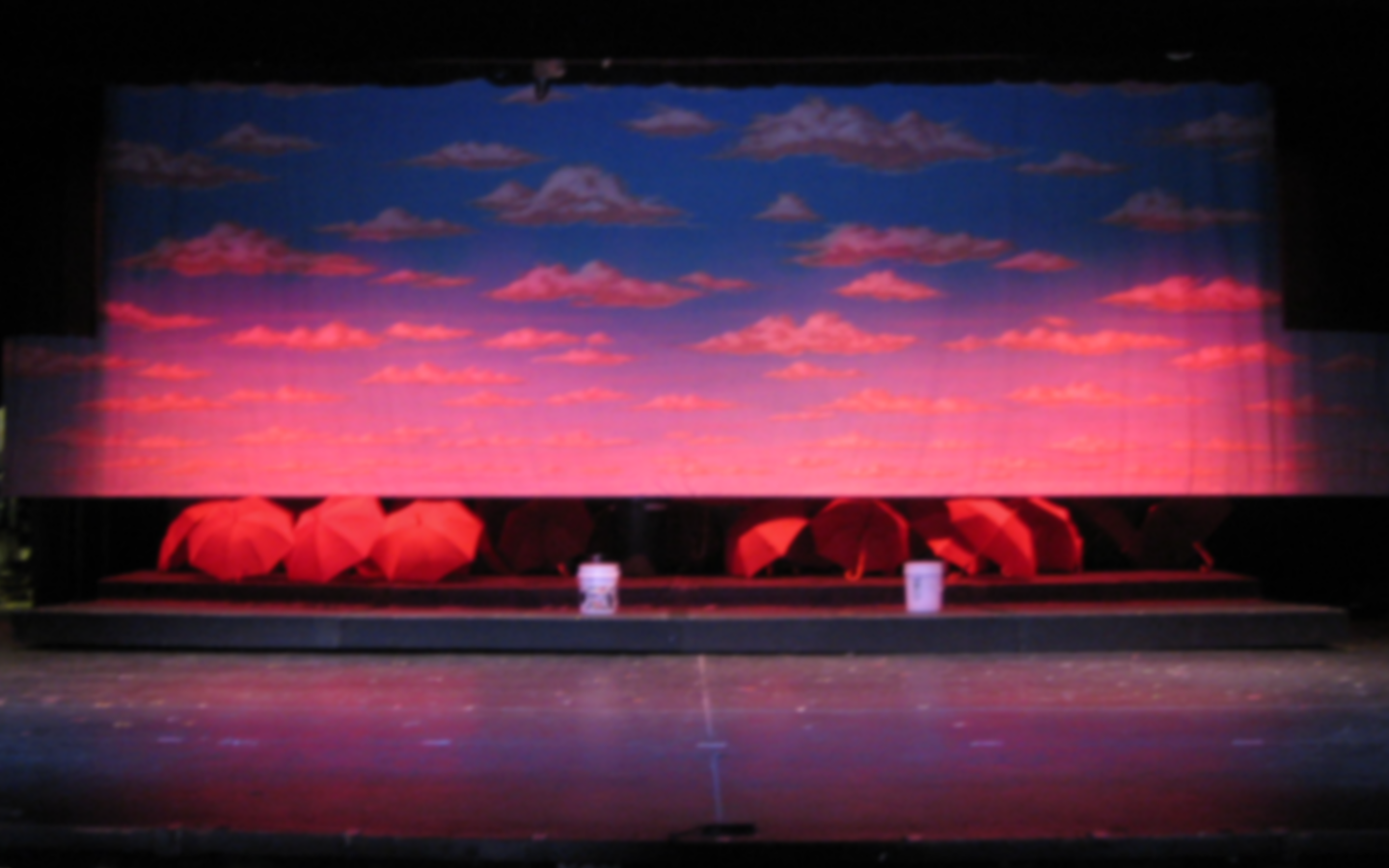
Umbrellas Under Sky with Buckets: A Still Life

I call this: summer stock — Posted by KP @ 10:06 pm


I asked as I left the theatre tonight, “For a show that’s going pretty well, why is it that we keep being here until 1AM?” In truth, it has nothing to do with how well the show is going, it’s been a different reason every night. Tonight part of the reason may have been that while looking at light cues at the tail end of our production meeting, somebody actually looked at what was on stage and realized how absurd it was, and that it would make a great art installation.

I wish I had a better camera, it would have been a great piece of art for a real photographer. Without using a flash my camera is always blurry, so I added some Gaussian blur in the hopes that it would look more intentionally blurry, and suitable for use as a desktop, which is what everyone seems to want. So I’ve made it 1440×900 for our Mac-using production team.

The completely rational explanation for all this is that we had flown in this sky drop to make some changes to a series of sunset cues. The 30-odd umbrellas were put out to dry overnight after having been used in the finale, and the buckets are there to catch remaining drips from the rain nozzles.

Anyway, I’m fried, but the run went pretty well. I’m still shaky on the second half of the second act, but a lot of the cues in the ballet would have given an observer the impression that I knew how to call them. I think we’ll be fine. This was the first run that actually felt to me like a performance rather than an experiment in technical theatre. Well it really was the first run without stops, and I think we’re in good shape. No rehearsal except the final dress tomorrow, and the dancers are coming in a half hour early because they wanted to go over the lifts in the ballet. I can definitely see the light at the end of the tunnel.
June 11, 2007

First Dress: Looks Like a Show

I call this: summer stock,theatre — Posted by KP @ 11:06 pm

It’s 2AM and I just finished my duties on my daylight day of rest. I left the theatre around 1:06, having rehearsed 7PM-12AM, and then with a production meeting to discuss notes on the evening’s dress rehearsal, disconnecting my computer from the projector, and moving my crap off the tech table and back to the booth, it took a while. The show actually went pretty well for a first run, and my anxiety about calling was mostly unfounded. I did indeed sit in the very nice laundromat (they sure don’t have couches and coffee tables in any laundromat I’ve seen in NYC!) and put the warnings in my script, which gave me a chance to sit and focus on the order of the show and clean up my book. I’m pretty happy about it. I actually learned the show itself better than I expected before we started tech, and just needed to learn my cues. Today I started to feel like I’m also familiar with my cues, and even the ones I didn’t get right today now make sense. I wouldn’t want an audience to see the show tomorrow, but if they had to, I’d have a decent shot at not embarrassing myself. Which puts me in good shape, since I have tomorrow (Tuesday), Wednesday, and a special school performance (at 9-o-freakin-clock-in-the-morning) on Thursday, if you count that as “practice” before the first paid public performance on Thursday afternoon.

Even when things are going well I’m usually reluctant to give up the security blanket of calling at the tech table, where I’m closer to the stage and can hear and see better, and have an actual sense of the artistic vibe of the show. Once I’m in the booth 100ft away and seeing through glass and hearing through speakers, I have to rely on my memory of what it felt like in the house to know what the audience is experiencing and how I can shape that. In a perfect world I prefer to move to the booth having already settled on the ideal placement of all my cues, knowing I like what they’re doing, and then I can just try to recreate that from the booth. Of course I keep tinkering, but it’s a good foundation. I’ve been calling Phantom for over three years and there are still cues I’m not satisfied with. The biggest reason for that is that I’ve never been able to call it from the front. Such is the disadvantage of being a replacement or sub. It’s not just a matter of trying something and deciding if you like it. Just figuring out what the audience is seeing requires major research. And I’m a little bit OCD about Phantom — I won’t be satisfied until every one of the 400-odd cues are perfectly placed down to the nanosecond.

If it weren’t for the video component of Singin’ in the Rain, I’d spend another day at the tech table, but I’m eager to run video myself so I get a few tries at it. The VGA cable is just long enough to reach out the door of the booth to near the sound console, and the assistant engineer has been nice enough to let me call video cues to him so I didn’t have to be up there. I’ve noticed the response time when I’m calling video is longer than I’m used to, I’m not sure if it’s a delay in the computer because of the size of the files, or that the videos themselves have a second or two of black at the beginning, but it’s something I’ve had to make an adjustment for when calling, and getting to run it myself twice before an audience sees it will make me feel better. I also don’t like to get in the booth too late in the process, because sometimes there are surprises, like I discover I can’t see something as well as before, or the orchestra part I was listening to to call a certain cue is difficult to hear in the monitors. I’d rather discover these things while I still have one more chance to do it, so I can confirm I’ve solved the problem before there’s an audience. There’s few things scarier than changing something before the first performance and thinking it will work, but not having actually tried it.


June 10, 2007

And on the 7th Day, We Went to Work at 7PM

I call this: summer stock,theatre — Posted by KP @ 10:31 pm

Tomorrow is our daylight day of rest, which means our day off is not really a day off. It’s allowed on a lot of contracts for the week of the first public performance. It means that on what would normally be the day off you can rehearse, but you have to start after 7PM. At Reagle this feels something like a regular performance day. We come in, run the show, do notes and go home. If there is extra time and problems to be fixed, selected trouble spots will be worked either before or after the run. I find it a pretty relaxing day, because I figure we’ve gotten through tech, and even if something bad happens, it’ll be over in five hours or less.

The only anxiety left is how comfortable (or not) I am about calling the show. Sometimes I feel ready to do it for an audience, sometimes I don’t want anybody to see it. On this show, aside from a few musical cues I need to learn better, I find that the cues I miss are because I can’t talk fast enough to call them. Sometimes there’s more to explain than there is time between cues. Reagle doesn’t have a cue light system, so everything is verbal, which is challenging, but it’s good exercise. Once I have a better idea of what comes next and just how much time I have, I’ll know when I need to abbreviate. Better/earlier warnings will also help me to avoid having to say too much with the actual cues. I actually don’t have the warnings written in my book yet, I’ve just been flipping ahead to the cues themselves and reading them off. I plan to bring my script to the laundromat tomorrow and work on it then. That’s all I’ve got planned for the daylight day of rest. Well I might go to the Apple Store and see if they’ve got one of those DVI-to-RCA/S-video adapters. I almost needed it today for the projector and was kicking myself for not buying it during the week.


Tech

I call this: mac,summer stock,theatre — Posted by KP @ 8:01 pm

Well I’m finally home. Haven’t posted anything in a couple days, because we’ve been in tech. One of the more interesting parts of the process (at least if you’re blogging about stage management), and of course the time when you’re least likely to be able to do anything like blog, or sleep or eat for that matter. I did go around with my camera in my pocket at intermission on Saturday and took a few pictures.

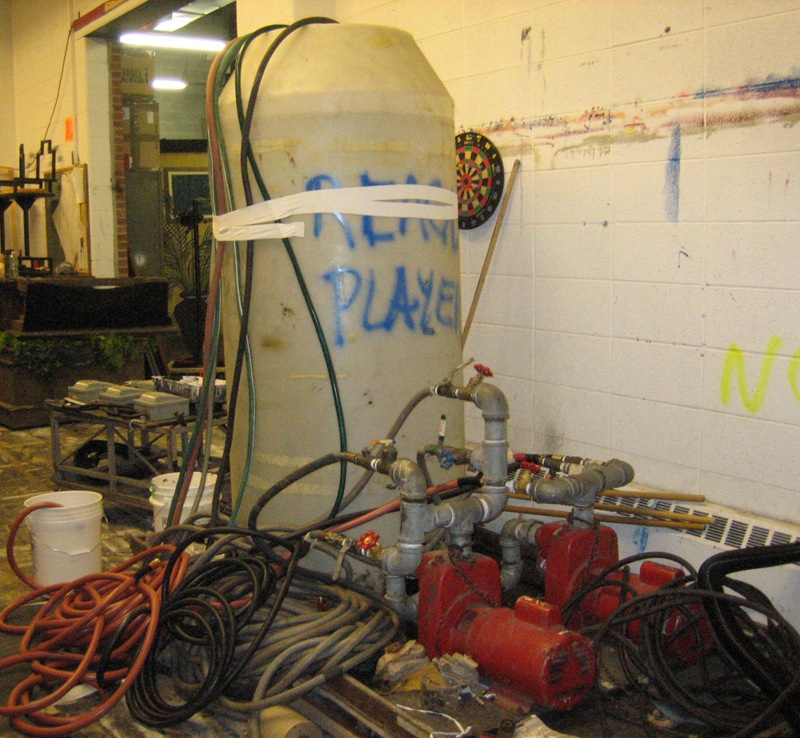
This is the rain machine. I don’t profess to understand how it works, and quite frankly, I don’t think I want to know. I know there’s a big tank of water, two pumps, and a whole lot of hoses.

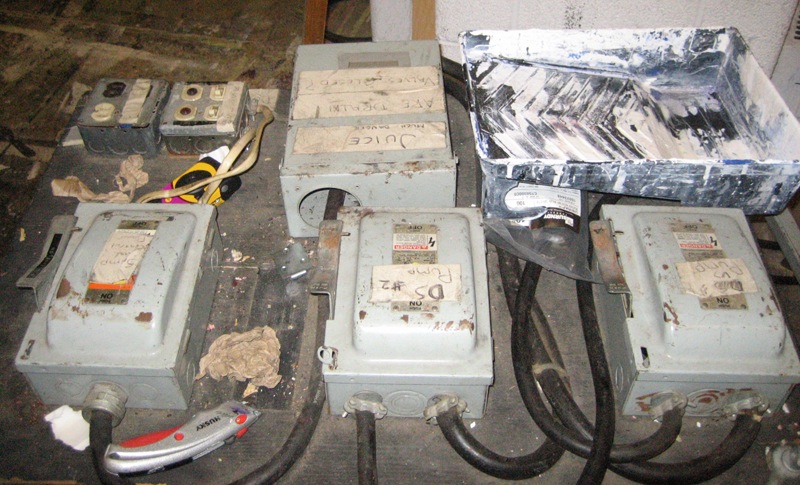
When taking that picture, I stumbled upon this, and discovered it’s the controls for the rain machine:

Now I’m sure I don’t want to know how it works.

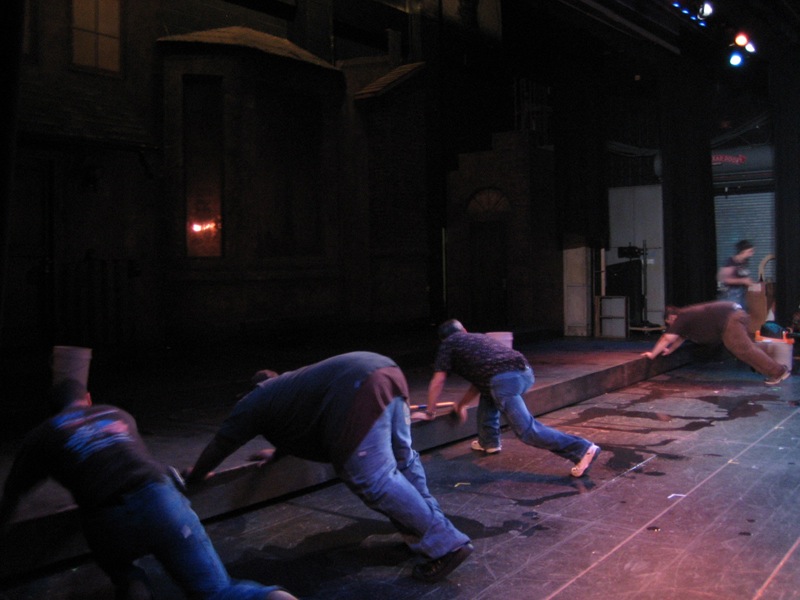
Here’s the crew pushing the rain deck back to its storage place upstage.

The rain deck consists of two levels of platforms (street and sidewalk) and the buildings behind them, and in theory all the rain falls on those two platforms and drains away instead of winding up on the stage. For the most part that’s what happens, given that it’s pouring rain for about five minutes. You can see as they push it (having mopped and vacuumed the water off first), it reveals the relatively small amount of water that found its way underneath to the actual deck. Some more water winds up downstage and on the sides, as there is much splashing in puddles during the dance, and inevitably some of the splash reaches beyond the rain deck.

At some point in the past week, I very quietly asked our TD if she remembered where in the show they had gotten at the end of the first day of tech the two previous times they’d done it. She didn’t remember, but I mentioned (even more quietly) that I was secretly hoping we would at least make it to the rain at the end of Act I. I didn’t say this to anyone, but it would have been my mark of personal failure if we hadn’t gotten there.

On Friday we spent the evening doing something I have come to call pre-tech. I started doing this in the middle of my first season at Reagle, and it has become my secret weapon to a successful tech process. It’s a run of the show on stage, but to that I like to add about four crew people, usually one a prop person. The goal is to introduce whatever technical elements are feasible without getting in the way of the fact that it’s still a rehearsal for the cast. The motto of the day is “This is Not Tech.” The lighting designer may throw cues on stage, but there is enough house light and work light that the stage is never totally dark, and any set pieces that are too complicated to be used by the cast without any preparation are not used.

During the dinner break on Friday we had our paper tech, where the various departments give me my cues, with the director and choreographer also present to discuss placement and intention of the cues. Because the show has been done before by most of the same people, things were very much in order before tech. The light cues were already written (although they are by no means left as-is from the previous production, there is at least a disk of workable cues to start from). So I was able to start calling the show less than an hour after finishing paper tech. That’s a huge advantage for me to start tech having more or less already called a run of the show.

By the time we finished pre-tech on Friday, I had revised my doom-and-gloom scenario about where we were going to stop on Saturday. Whereas before I would have been content to finish Act I, I was now almost certain we would end the day somewhere in the 13-minute ballet that makes up a large part of the second act. And indeed that’s what happened. We ran it in sections, as there are several distinct parts of it, and then stopped for the night when we reached the end of our 12-hour day.

I got about two-and-a-half hours sleep Friday night, which is not the best way to go into tech. For me, the longest night on any show is the night before tech, because I have usually just gotten my cues, and have to do my homework to come in somewhat prepared to call them the next morning. This can mean cleaning up scribbles in my script so it’s more legible, studying recordings of the show to learn parts of the music I don’t know well enough, or just reading through everything so that I familiarize myself with what comes next and what the tricky sequences will be. It’s also the night to do whatever hasn’t been done yet, which is how it winds up extending to 5:30 in the morning. Up to this point, the director has been in charge and I’m basically an administrator making sure things happen and everything is documented. On the first day of tech the show is turned over to me and absolutely anything that’s wrong or not done from that point until the show closes is my fault. So if I don’t think I have everything in order I will stay up until it’s done. Only once in my career have I actually worked straight through the night and finished at the time I had to leave the house the next morning, and that was quite a few years ago. As I laid down to bed on Friday night I could faintly recall a Reagle show where I got 45 minutes sleep, but I can’t remember what it was or what the hell took so long. If I’m lucky I can get a decent amount of sleep, but I didn’t leave the theatre until midnight, and wanted to spend a lot of time looking over the show, especially the ballet.

So Saturday we teched from the beginning up to the ballet. Sunday we ran the ballet first thing in the morning, and relatively quickly finished the rest of the show.

On the lunch break (named for the fact that apparently some people got a chance to eat), we worked on getting the projector focused more accurately on the screen drop, and confirmed our hope that it could also cover the projection onto a different surface which had in previous productions been done with a second projector operated by the conductor from the pit. Because we’re running it on my computer in Keynote, we had the flexibility to resize and crop the videos in a variety of ways without ever touching the projector, allowing the whole show to be run from the single projector hung over the house. This is greatly pleasing to everyone, as it will be more reliable, saves the conductor and orchestra from inconvenience, and saves the theatre $1,300 on the rental of the second projector. Since some of the video files are very large, we were concerned about the ability of any laptop to run a video smoothly without using too much compression and degrading the quality. Because of this I decided to buy the 4GB of RAM that I was going to wait a year or more for, and paid for extra-super-fast-overnight-Saturday-delivery so that we would have it in time for tech to see if the videos ran smoothly. They’re looking great, and today we even replaced the longest one with a higher-quality version that’s over 700MB, and it runs beautifully. We’re going to use the same compression settings on all of them now. Even before upgrading the rest, the show file is 1.78GB.

After lunch things did not go so well. We were planning to run the show, but there were still a number of unresolved issues that resulted in a run with a number of long pauses, and a few scene changes being run again. We added a number of costumes even though the first official dress rehearsal is tomorrow. We knew there would be quick change issues, and there were. Finding them today, while frustrating, means we will have a smoother run tomorrow. There were also some backstage and onstage traffic issues that required discussion. As Act I got longer, we debated over the course of several hours whether we should use the rain at the end of the first act, because it can take up to a half hour to vacuum up the water and set for Act II. After changing my mind at least half a dozen times as the situation developed, we decided to skip the scene and come back to it at the end of the day so that the cast could do notes while the water was cleaned up. It wasn’t the ideal way to do it for a lot of people’s processes, including mine, but we did get through the whole show, and I’m not sure we would have if we had gone in order. We also saved time by starting Act II (which is a collection of book scenes with the ballet in the middle) with the dancers going off to the rehearsal studio to go through their lifts and other tricky parts in costume so that they would be ready to run it straight through on stage without any problems or injuries from unfamiliarity with the costumes.

When we finished we did some notes until it was time for the dinner break (during which I’m told some people had the opportunity to consume food). I went to the “band room,” which is just that, a high school band room, where the orchestra was setting up for their first rehearsal. Our sound guys had already set up the room for recording a few tracks to be dubbed into the videos used in the show. We weren’t sure how everyone would be able to see the video to sync the music. The rough plan was to use my computer screen and an external monitor taken from… somewhere… and hope everyone who needed to see it would have a good view of either screen.

When I went into the band room to scope it out, there was this large whiteboard on wheels. If only we had a projector other than the one that was lashed to a pipe on the ceiling in the theatre… Like the second projector we rented that we didn’t need and would be returning in the morning. Problem solved. So after getting notes from the director and lighting designer, that’s what I did on the mythical dinner break. We placed the whiteboard behind the orchestra so that the conductor could see it, as well as the actors (basically the entire cast) who were standing in a crowded clump off to the side. It set up in just a few minutes and it looked really good. Again, Keynote makes it so simple. I made a copy of the file I was using to run the show and got rid of all the clips we didn’t need for recording, then with a click-and-drag made the videos as big as possible (as opposed to the show file, where they’re smaller to fit exactly onto the screens on stage). My headphone output was connected to the sound equipment, and a simple click of the mute button on the Mac allowed us to alternate between hearing the original tracks for reference, or having it silent to be sung/played over. For one track, the conductor needed to hear the audio on the original recording in order to cue the musicians and singers in, and he was provided with headphones to monitor the audio from my computer. The whole event went very smoothly, and we only needed a couple takes of each one.

The cast stayed to sing some of their songs with the orchestra, but it had been a long day and they were released long before the scheduled 10:30PM to go home and rest and watch the Tonys. We had a TV in the scene shop on which I caught some of it, and even I got home before it was over (stopping at Burger King on the way for my first meal since I went to Dunkin Donuts at 9AM). No big surprises with the awards, it seems. I didn’t get a chance to see most of the nominated shows, including Grey Gardens and Spring Awakening, so I really didn’t have strong opinions about it. I’m just glad tech is over.


June 6, 2007

Meanwhile, something about a show

I call this: mac,summer stock,theatre — Posted by KP @ 8:56 am

I wasn’t the only one who thought my new Macbook Pro was the most important thing to happen at the Reagle Players yesterday. We have quite a few Mac users among the creative team, cast and crew, and many people were very excited to come back from dinner and see my new purchase. I had just enough time to drive up to Burlington, buy it, swing through Burger King and get back, so I didn’t have any time to start playing with it. In fact I didn’t even open the box until the first break. But then much oooing and ahhhing commenced.

I did basically one thing with it during the entire evening at the theatre, which was to set it up to use my Treo as a modem, and then download a small app to check the LCD for stuck pixels. It’s one of my bigger fears in life to spend lots of money on some wonderful computing device and find it’s got a bad pixel that I’ll have to stare at for years to come. I watched the white screen carefully as it booted up for the first time, looking for any signs of uneven backlighting, bad pixels, or other display problems. I am happy to report that this machine passed the LCD test with flying colors.

But anyway, in the midst of this important event, in the background we continued trying to put on a show. Last night we did a work-through of Act I, which was very exciting. It wasn’t quite a run, but moved fairly quickly. We were also able to have rehearsal on stage, which was very helpful for everyone. It’s definitely starting to look like a show, and it was the first time that the ensemble got to see a lot of the principals’ scenes and musical numbers, so it was kind of like having a real audience. “Good Mornin'” brought the house down.

As Singin’ in the Rain comes closer to completion, I was also greeted by this sight as I pulled into the parking lot before rehearsal:

The set of King and I under construction and being painted by the talented Matt and Jamie. A lot of Reagle’s sets are rented, or purchased from other renters, but this one is being built and stored in the back warehouse. A lot of it was already constructed when I arrived for the summer, and this week they have started painting.


June 5, 2007

A Puzzlement

I call this: computers,mac,summer stock — Posted by KP @ 8:51 am

An interesting question arose as I typed my last post (about the purchase of the Macbook Pro). I said that I had been in need of a new external hard drive for some time, but have been waiting to see what the capacity of my new computer would be before deciding on one. Here I am up here in Waltham, without an external hard drive. My backup program (Intego’s Personal Backup) nags me every few days about how I haven’t done a backup since 5/22/07, and with the entire Reagle season sitting on my 4-year-old hard drive, don’t think this doesn’t worry me. It’s been on my Treo’s Todo list for a week, “Backup to DVD.” Have I done it yet? No. It takes for-freaking-ever, and I’ve been busy, and when I’m not busy I’m lazy. But I really should. But as I have to leave for rehearsal in a little over an hour, now I don’t have time. See how this happens?

Anyway, all this musing about getting that external drive ASAP led me to mention how important it is, since my computer will be running all the video for Singin’ in the Rain. This is one of those shows where the projections aren’t just pretty, they drive the plot. A crash or deletion of something important would need to be able to be fixed right away, on-site.

As I typed this, this is where the puzzlement struck me: if my Macbook Pro arrives somewhere between June 8-13, as Apple says, then it will either be right before tech, or right before the first performance. Which computer gets to run the show?

In this corner, we have the Powerbook. I’m typing a freaking blog post, and the hard drive is cranking, the fan is spinning, and it’s beachballing for a second when I switch between Firefox and Entourage. It’s old, and while it’s done fine for basic projections, sometimes I wonder if it could still handle full-motion video and audio. This machine has been running projections for professional theatre since I bought it. Its credits include the tour of Abundance, Earthquake Chica at the Summer Play Festival 2004, The Reagle Players’ production of Thoroughly Modern Millie, the comedy show Laughing Liberally at Town Hall, and the Charlie Chaplin musical Behind the Limelight, where it ran the coolest cue I have ever called in my life (actor-Charlie walking into the screen and disappearing into it as the real Charlie appears in his place on screen and shuffles off into the distance). I have never, NEVER had this machine fail in performance. I once had to start an invited dress rehearsal 20 minutes late because Keynote 1.0 used to crash occasionally when you tried to save, but that’s a separate issue. I have run all three versions of Keynote on it, and it has been 100% reliable in performance — no delays, no mistakes, I have called thousands of cues on it, and it’s as accurate as calling a light cue. However, due to its age, and the fact that it sometimes has trouble, you know, rendering a web page… I worry that someday I’m going to ask it to run a full-screen video with audio output to the sound board, and it’s going to have to think about that for a second or two. In its defense, last December it did run video with audio at Laughing Liberally, and to my surprise did just fine. It was a very last-minute thing. I got to the gig about six hours before the show and said, “You’re running video by hitting pause on a DVD player? Gimme the files and half an hour!” I was a little concerned that it could handle it, but it seemed fine to me.

In the other corner, we have the newcomer. So much faster, I’m not even going to try to quantify it. Will there be enough time to make sure it doesn’t have something wrong with it? A habit of kernel-panicking just when you least expect it? The Powerbook has recently taken to kernel-panicking when I wiggle the connector for my USB hub, but at least I expect it. Of course the earlier the MBP arrives, the more time there would be to test it. But five days of tech and dress might not show all its flaws compared to almost four years with the Powerbook. But it’s my new toy!

I think I will try to use the Macbook Pro, as it has to do its first performance someday, just as the Powerbook did when it was new. You can be sure the Powerbook will be sitting in my bag right behind me in the booth, with the current show files on it, ready to be swapped in if there’s a problem. If the MBP doesn’t arrive until the middle of tech, I will need a day or two to get all the software on it and make sure everything’s good. In that case I may decide to make the switch for the second week of performances, in the meantime letting the MBP get on the projector and run through its cues before the preshow check. It would also be interesting to project both on stage and see if there’s a difference in the quality — if the MBP is rendering noticeably better, that would be an argument for using it as soon as it’s ready. We will have to see.

There are also other important uses for the machine that runs the show projections: we have plans to do a screening of the original movie for cast and crew at some point. And most of all, and I promise to take better pictures of it this time, here is Super Mario Bros. 3, arguably the greatest game of all time, being played on stage during the dinner break of a tech rehearsal for Thoroughly Modern Millie. What you can’t hear is the game audio plugged into the sound board and being blasted through the 1,100 seat theatre.

We had several problems here: there wasn’t really a projection screen to use, as in Millie the only projections are supertitles that translate the comic brilliance of the two Chinese characters. For this reason the projector was tipped up and not really centered on stage, and the screen was just a narrow strip three feet tall. Also, we did not have a light-colored drop to bring in as a projection surface except one that was way upstage. This time, we will have a real screen to play with.


June 3, 2007

Yay Dimmers!

I call this: summer stock,theatre — Posted by KP @ 7:46 pm

I had heard through the grapevine that we were renting enough dimmers for this show that there wouldn’t need to be any patches during the performance. At the production meeting yesterday we actually got approval to buy the dimmers, and a multicable to the catwalk that will apparently alleviate some kind of lack-of-circuits problem that’s always an issue up there. That’s exciting — any decent design at this theatre has required a dimmer rental, so it’s a great investment in something that always winds up being rented anyway. Even with renting more dimmers, we usually wind up with a few patches during the show, which is never fun, and I’m never 100% sure I trust that it’s been done.

For those who don’t know, briefly, patching is done when you have more lighting instruments than dimmers, like you have two lights that you want to do different things (say one’s red and one’s blue), but you only have one dimmer available to control them. If you use the red light in scene 1 and the blue light in scene 3, then during scene 2 you can unplug the red one and plug the blue one into its dimmer. At the light board it looks like it’s bringing up the same light, but a different one is physically plugged in (or in many cases a switch box is used for the same effect — sending the current out to a different light depending on which way the switch is thrown).

    Favorite patching story: Two years ago we were doing Sound of Music. In the scene at the end where the von Trapp Family is performing for the Nazis, there were these ominous swastika gobos that appeared over the family’s house at the end of the scene where the Nazi officer demands that they perform at the event, and as the family steps downstage and the red velvet curtain falls behind them, the gobos came into focus and created the effect of Nazi flags at the concert hall. It was quite effective. So while we’re teching, the lighting designer says something to our deck electrician about making sure he’s done the patch for the swastikas. Now, having had a less than perfect rate of success with patches being done properly before, I asked, somewhat hesitantly,

    “So the swastikas are part of a patch?”
    “Yes.”
    “And what’s the other side of the patch? When should I be expecting to see swastikas if the patch isn’t done correctly?”
    “Oh, it’s not used much. It’s the stained-glass windows in the church.”
    “So you’re telling me if the patch isn’t done, I’m going to see swastikas in the church!?
    “Well theoretically, but the church scenes are first, so if the patch wasn’t done you would see the church windows in the Nazi scene — you would only see the swastikas in the church if they forgot to reset before the next performance, which is much less likely.”
    “Okay… You’re right. I just wanted to be warned.”

    Cut to a few hours later. We finish teching Act II, and quickly reset for a run of Act I. The show starts — the nuns are holding candles, singing a hymn behind a black scrim. It’s all very dark and mysterious. Next cue, the stage brightens up and we’re in the…. SWASTIKAS! The nuns can see this because there’s a scrim in front of them catching the light. Several scream. I turn to the lighting designer and say, “That’s why I wanted to know!” Of course she was right about how unlikely it was, it only happened because we did the rather unusual process of starting the day with Act II and going back to Act I.

That’s one of the reasons I worry about patches. During some patch-heavy shows at Reagle, I started referring to the process as “patchy-patchy.” I think it was because I had trouble remembering to confirm that a patch had been done at intermission of a certain show, and kept writing the reminder bigger and bigger at the top of the first page of Act II, and eventually wrote “PATCHY PATCHY!!” across the entire top margin. The head electrician saw my note, and it became a verbal term as well. By the end of last season, it was a well-understood technical term. When a patch came up, I would say, “Patchy-patchy?” and if it was complete the deck electrician would reply, “Patchy-patchy.” Since that came into use we’ve had a lot more success — I think because it’s so much fun to say that you don’t forget. I’ll kind of miss it if we don’t need to do any this year.


End of Week 1

I call this: summer stock,theatre — Posted by KP @ 6:51 pm

Well we’ve survived the first week of rehearsal. It actually went much smoother than I thought. I always relax more the closer I get to tech, which may seem backwards, but I take comfort from knowing what’s going on, even if what’s going on is huge and insane and may or may not work and it’s all my responsibility. At least I’m in control of it, and when the job starts to become more “stage” than “management,” that’s the part that’s fun. Nobody in their right mind would be a stage manager just because they need a job. There are plenty of other careers you could go into if you don’t care about doing something you love. So I always like to get to the part that makes me look forward to going to work.

A big hurdle for me yesterday was our production meeting. Our first week had been rather hairy schedule-wise, and I was becoming very unsettled about how late into the process we were getting without a full meeting, even if most people involved had done the show before. It was looking like we wouldn’t be able to have one until this coming Tuesday, but when I started to type the e-mail I just couldn’t bear to do it — that’s five days before tech. So with a little bit of begging and pleading, I managed to get everyone to clear their schedules so we could do it at 6PM last night, immediately following rehearsal. We had a lovely meeting, of an hour-and-a-half duration, at a rather relaxed pace. Nothing huge came up, but it was just nice to all sit down and say stuff out loud and face-to-face and make sure everybody was in agreement. We hammered out a slightly different schedule for tech, due to the need to record the orchestra and vocals for one of the movies-within-a-show. We got approval to buy additional dimmers, which is cool. Basically I just felt good that we all sat together and no major crises came up.

I was also feeling rather behind, as I’ve said before, because almost everyone has done the show, and I didn’t get much time to prepare before coming up. I was kind of dreading the production meeting because I was afraid I’d have stupid questions. So to prevent my displaying my ignorance at a meeting I’m supposed to be running, I had my “Meeting with Lori” a little early. I haven’t come up with a better name for this kind of meeting, but I’ve been doing it on a number of shows now, and it works wonders. This is when I find a couple hours to sit down with our very busy TD and she hands me a stack of paperwork if I don’t already have it (fly plot, scene shift plot, etc.) and I break out my script and we just talk through the show. It can take a while, because it starts out slow, going step-by-step. What drops are in, what pipes are they on? (I try to memorize the fly plot early because it gives me a good sense of proportion — how much room various scenes take up and where they play in reference to one another.) The real point of the meeting is to have it before tech so that we can be sure there’s no miscommunication or a change that didn’t get noted — she reads her paperwork and I read mine, and we state how we think the show goes and make sure we both think the same thing. This way when we get to tech nothing I call should surprise the crew, and nothing they do should surprise me.

We discuss absolutely everything that moves, and she will point out potential trouble spots from past experience — this unit is huge and barely fits through where it has to go; this move requires tons of crew; you can’t bring in this drop until the set is pulled upstage; this is a scene change that needs to be run in the light before trying it in a blackout. In places where I don’t quite grasp the enormity of it on paper, we walk out to the stage and I look at the set piece, look at the width of the wing, look at where the drop is hung, then we walk it, we stand where the pieces will go, we walk off like we’re carrying a huge table, the table goes off and turns this way, the doors go off and turn that way, meanwhile the stairs are coming in here. So when the stairs come on the big unit is clear to move to its storage space. It all starts to make sense, in a good way and a bad way — good because I now understand exactly what has to happen, and bad because I understand why it’s going to be so difficult. But as I said earlier, I don’t care if it’s difficult as long as I know what’s going on.

All these things are very helpful, but the best result of the meeting is that I start writing tentative cues in my book. Even if they’re not in exact places, it helps me the next time we do the scene in rehearsal to see the cues there and start thinking about where they might go. Do I need to learn an actor’s mannerisms to catch a visual cue, is it a piece of scene change music I need to concentrate on? Do I need to wait for an actor to cross downstage of a drop before bringing it in? When is he crossing? Then rehearsals stop becoming about the actors’ process with me just being an administrator. It starts to become my process, too, and I can visualize what I’ll be doing during these scenes we’re working on.

We didn’t quite get to do a run of the show as was optimistically put on our schedule for today, but we’re very close. I thought today was a great day. We did only the big group scenes, in order, including one big one we had not yet staged, and we took the time to make sure everything was running smoothly, not just that it was blocked. It was also the day the ensemble and the principals finally got to spend some time together. I always think that day is one of the more magical moments of the creative process.

With many shows, rehearsals are broken up and the dancers are rehearsing in one room with the singers in another, and the principals off doing their scenes somewhere else. There may be a principal leading a dance number, or a singer playing a speaking role in a book scene, but by and large the groups don’t get to spend much time seeing what others are working on, while all working towards the common goal of putting on this show.

Then comes a day when the show starts to be put together in large enough chunks that your rehearsal schedule for the day looks something like:

Review scenes and songs    All   

Then everyone gathers in one room, and sits around and watches everything. The ensemble finally gets to hear the leading lady sing her big song, the principals get to watch the dancers do the big tap number, and everybody laughs and cries at scenes they haven’t seen. Today one of the most minor of things we hadn’t staged was the few background crossovers that happen during the rain scene at the end of Act I. Just a couple people running by with umbrellas and stuff, as the two leads walk through the scene. But I would say it was one of the highlights of the day. There were very few props — Don had his umbrella and hat, one passerby had a page of a newspaper to hold over his head. Just a rehearsal studio, no set, no lighting, no rain. He didn’t even sing the song, just a few bars at the beginning and a few at the end, but I think we all saw the show come to life there. I’ve seen him do the whole number a few times, but there was something about doing the scene with the whole company sitting on the sides, and adding the people walking by that made it suddenly look like a show, and it was easy to imagine how magical the scene will be. Even skipping the song itself, the room broke out in sustained applause when we reached the end of the act. I definitely feel like today was the day the company became a unified entity, and I’m looking forward to the next week as we put larger pieces together — Act I on Tuesday, Act II on Wednesday, and then a run in the studio Thursday, a run onstage Friday, and finally starting tech Saturday.

Stay tuned. Tomorrow’s schedule involves doing laundry, going to the Burlington Mall (for needed clothes, The Body Shop, GNC, and a trip to the Apple Store), and spending too much time on the internet. Tuesday, if you believe the rumors, may see the release of the long-awaited Macbook Pro that I will finally purchase.


Singin’ in the Rain, Remastered by George Lucas

I call this: summer stock — Posted by KP @ 6:44 pm


One of my actors just sent this to me. As a fan of the un-altered Star Wars movies, and as PSM of Singin’ in the Rain, I find this hysterical in so many ways.


May 31, 2007

The Rehearsal Report

I call this: mac,summer stock,theatre — Posted by KP @ 8:40 pm

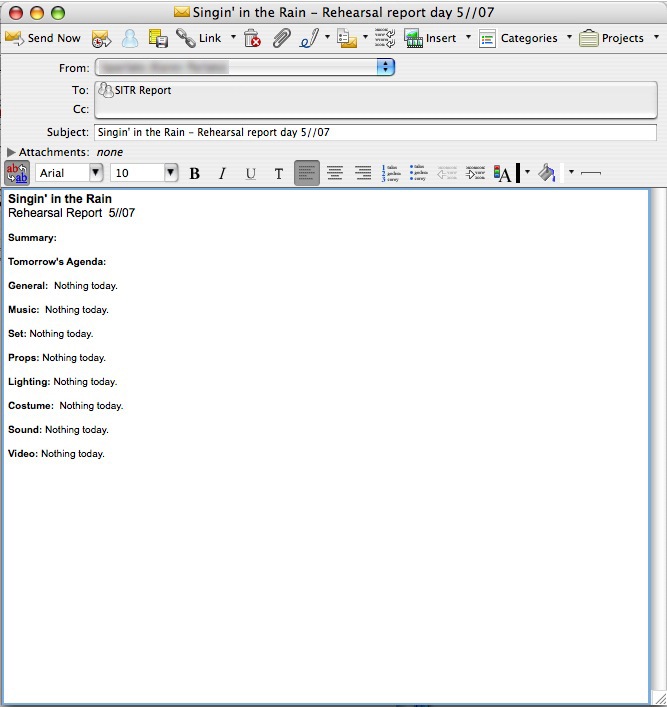
Time to give the rehearsal report it’s own featured post. To your right, you will find a picture of my template for the report (click to see it full size). I keep this e-mail-in-progress saved in my Drafts folder in Entourage. At the start of each day, the first thing I do is select it and duplicate it (Command-D), so now I have two — one to work on, and one to stay as the template. It’s already filled in with all the information that doesn’t change: first the addressees (a group defined in the address part of Entourage, in this case “SITR (that’s Singin’ in the Rain) Report”. So who gets the pleasure of reading my reports? It can vary slightly by show, but in this case:

  • The director
  • The producer
  • The assistant to the producer / costume supervisor
  • The choreographer
  • My assistant
  • The musical director
  • The conductor
  • The orchestra contractor
  • The tech director
  • The lighting designer
  • The sound engineer
  • The assistant sound engineer
  • The prop master
  • The assistant prop master

On the subject line, I fill in the day of the week, i.e. “[Thurs]day”, and stick the date in between the two “//”‘s. Same thing with the date in the main body of the e-mail.

I’m a fan of plain-text reports myself, because I like the idea that they can be read on a Blackberry, Treo, etc. and retain a semblance of proper formatting and legibility. Yes, fancy reports with tables and stuff look great on a full-size computer, but I prefer to know that everyone can read it the same way. I actually switched to using simple HTML this year, which displays fine on my Treo, so I think it should be acceptable to mobile users.

I break up the report into simple categories. Summary is basically what we did today, i.e. “Blocking for “All I Do,” scene I-4 and I-5, choreography for the ballet…” that kind of thing, or if there was a production meeting, Equity meeting, anything else of note (although a production meeting will then get its own separate e-mail outlining everything that was discussed).

Tomorrow’s agenda is the span of day, time of the meal break, and on a show like this which publishes a weekly schedule of what’s being worked and breaks down call times, I only go into further detail if it differs from the published schedule.

General is just what it says. It might be an actor who dropped out of the show, upcoming conflicts for actors, a problem with the air conditioning in the studio, anything that doesn’t fit in the categories below. One of today’s general notes concerned these lightweight plastic chairs in the downstairs rehearsal studio, which for the second time in as many days have spontaneously had a leg snap off while an actor was sitting in them during a scene. Thankfully neither actor was hurt, but from now on we’ll only be using the folding chairs from the upstairs studio. I put it in the report the first time it happened only because we rent the studio and I wanted to document that the chair was broken during normal use, and not because anyone was standing on it, throwing it, etc. just in case the studio later complained about it. Putting things in the report is like having a receipt for something. If it was in the report on the day it happened, there’s proof that it happened and when, in case a question ever comes up.

This leads into another category which comes after General, but hopefully doesn’t have to be used: the Accident Report. Any time somebody gets hurt during the work day, even if it doesn’t require any medical attention, it gets put in the report, just in case. It doesn’t require any more paperwork unless they decide to see a doctor, at which point they need a C-2, but having it in the report on the day it happened allows them to later prove that it was a work-related injury if it becomes a more serious problem at a later date. For instance, my one and only appearance in the accident report at Phantom was when I was on the deck and through a series of unlikely events, was more or less punched in the side of the face through a masking curtain by the actor I was about to page the curtain for. Some combination of my headset and glasses created a small cut on the outside of my right nostril. When I had a moment between cues, I went to the office to check it and get a tissue, and that was the end of it. But imagine, if you will, that the cut became infected, resulting some days or weeks later in the amputation of my nose. No worker’s comp if it wasn’t in the report. Thankfully my nose is just fine, although on the third day the cut started to heal on the edges and the center turned pink, at which point it looked like a zit. I should have been entitled to payment for emotional damages after that.

The other categories below (Music, Set, etc.) I should think don’t require explanation. The video category is only included on shows that have a video component of course, of which this happens to be one. I keep the “nothing today” label in there, and type over it when I have something to say. Today I actually had something to say in each category, which is pretty rare.

I try to keep a lighthearted tone in the reports without wasting anybody’s time with stuff that’s silly or serves no purpose. A few things I’ve learned in life about reports are to think about whether what you’ve written is going to cause unnecessary panic, or if it will make people try to get involved in things they don’t need to get involved in. If there is time, there are some things that are best left to a private e-mail or phone call to the proper department, and when they have had a chance to come up with a response, then tell everyone else what the situation is and what’s being done.

I have learned from talking to producers and general managers that most of them like a lot of detail in reports, even if they have a lot of shows to follow. Especially in cases of running shows where the producer or GM is no longer actively involved at the theatre, the report is their link to what’s going on. The stage manager’s artistic opinions (whether the cast gave a good show, pacing problems, performances of understudies, etc.) are also welcome, because there’s no one else there to make those judgments, and otherwise the artistic staff won’t know when there’s a problem. When I was production coordinator of Bingo, being 1,200 miles away and having only the report to make me feel like I was there, I got firsthand experience in what someone in the office wants to hear from the stage manager. I have also been thanked by the creators of shows for the detailed reports, because it serves as a kind of diary for the creative process — some have told me that they’ve printed all the reports and saved them as a keepsake.

I write detailed reports, but I find they don’t actually take up too much of my time. I achieve this two ways:
1. Begin the report at the start of the day, even if it’s only to start filling in what scenes/songs you’re working on. Instead of taking notes throughout the day, type them directly into the report. By the end of the day the report is usually done, but I tend to wait until I get home to send it, just in case something comes up at the last minute.

2. Always finish the report before you start drinking. If you’re going out with the cast and/or crew after a show or rehearsal, take a moment and finish the report before you go. You don’t have to send it, just make sure it’s in sendable condition. It can be really hard to remember what happened that day if you wait until later, not to mention proofread. Then you can go out and relax and not have to put your brain back in work mode when you get home.


« Newer PostsOlder Posts »